Showing posts with label Biodiversity. Show all posts

Wednesday, 15 February 2012

Man And Nature (Within And Outside)

The presentation to the paper, "Architecture and Biodiversity in India : A Context to Aesthetics in Our Times", presented to PAITHRUKAM 2004: Seminar/Workshop on Aesthetics in Indian Architecture: Past, Present and Future, at MES College of Architecture, Trissure, Kerala.
#


Man And Nature (Within And Outside)


More PowerPoint presentations from Remigius de Souza

#

Note: 1. All the references and quotes are not mentioned in the presentation. Also, the permissions of the authors and publishers have not been taken. The author acknowledges their copyright. These are used purely for the academic purpose.

Remigius de Souza
~ ~ ~ ~ ~ 
© Remigius de Souza, all rights reserved

Wednesday, 21 December 2011

Indian Society & Some Crucial Issues: Worm’s Eye view

Indian Society & Some Crucial Issues: Worm’s Eye view
By Remigius de Souza

Key words: society; institutions; nature-conservation; people-conservation; village-education.

People Energy


ANY EVENT that I notice /read makes me to introspect, watch what is burning under my feet and what is happening around, as far as my sight can reach... with whatever means available.

THE WHOLE PAST comes to my mind like a movie in a flash ...from the age I came to senses, the Four Worlds of India — the Third World (of peasants), the Fifth World (of the marginalized), the Fourth World (of Adivasis) and the First World (of Industrial Society) — where I lived, moved, worked and gained experience. Following few observations are based on this lifelong journey.

Society
WE generally use word 'society' that refers to all social collectives. However, there are some fine differences among the Indian social & cultural sub-groups. Some are civilized societies; some are aborigine communities and some ethnic communities.

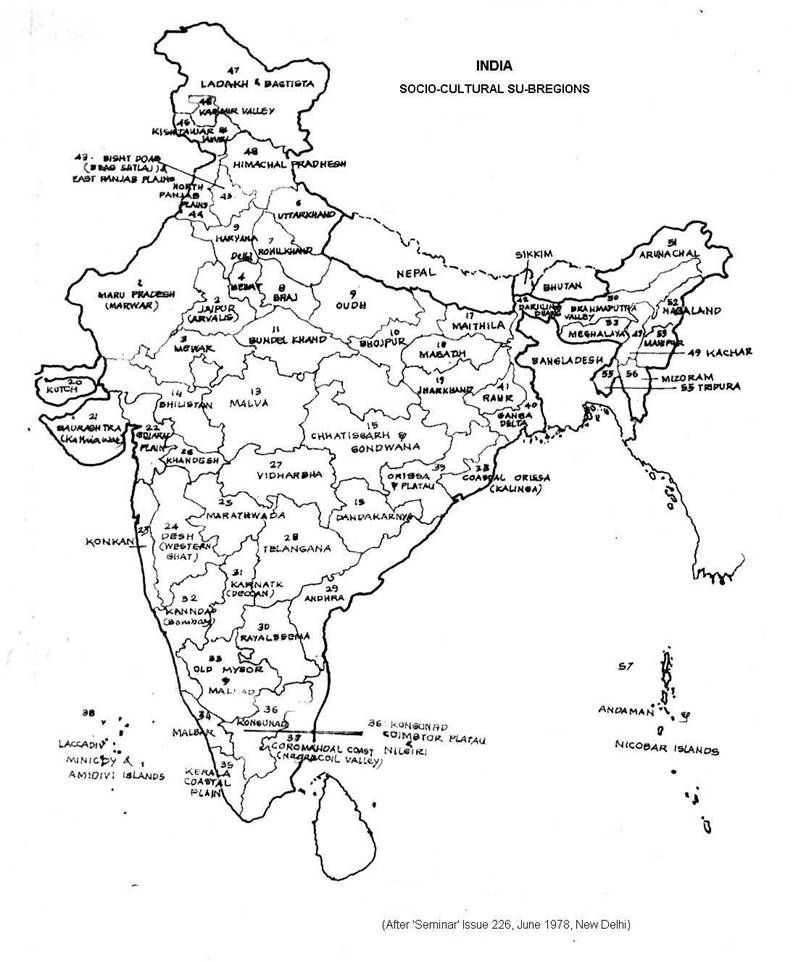
India: Socio-Cultural sub-regions
Restore Languages to restore People’s Autonomy. There are as many languages as the cultural groups.

THE COLLECTIVES of the aborigines or Adivasis are better addressed as 'communities'. Because their social formation is not based on division of labour, caste and class, like civilized societies. Here, every individual is representative of whole community. A notable feature: there is no prostitution among Adivasis!

THERE ARE some ethnic communities. For example, there is matriarchal ethnic community in Kerala. Before Aryans came, there was matriarchal society in Karnataka (Bharatiya Sanskritikosha, editor: Pundit Mahadevashastri Joshi). There are also communities of Laman or Banjara (Romano), Dhangar (shepherd) etc.
Distribution of some major tribes of India
Adivasis come with the wealth of their ancient wisdom. The loss of their Forest habitat means assault on their existence and survival.

INDIA STILL HAS RICH BIODIVERSITY; hence, there is rich cultural diversity. The culture is the gift of Srishti, ‘Mother Nature’, to humans! It is, therefore, necessary in India, to include the subject of anthropology in all branches of higher education. It is necessary for the elite to learn about plural society of India. History of India, introduced by the British, is too narrow, mean and out of right context. It propagates feudalism, which is not good for democratic values, than “People History”.

Institutions
THE COLONIAL RULE brought here industrialization from Europe. It dominated entire educated and illiterate society, before anyone realized. It was not a revolution; it was borrowing; it was imposed. Industrialization came, along came many institutions and complex laws. They took over the private and public life of the collective and an individual. And both lost their autonomy of self-decision and self-reliance.

Social Work
BECAUSE OF INHUMAN SOCIAL AND ECONOMIC INEQUALITY IN INDIA, many institutions, movements, activists… committed to social work started during past 100 years. However, we speak from a public platform; we take for granted what is below the platform, the reality that is constantly changing. We say 'Chalata Hai – This goes on,’. And the work that remains for the experts, professionals, politicians is to find "curative measures" to save their skin.

IS THE WORK of a teacher, doctor, technocrat, engineer, architect, Govt/semi-government-employee, city planner, economist, scientist... police not "social work"? Aren't they the part of society? Of course, in a decadent society — whether Western or Eastern — this may not happen. We, however, caress our ego. That's all!

NGOs
THERE ARE NGOs from UN at global level to countless numbers in the bye-lanes of Delhi-Mumbai... These social institutions are started with noble aims and objectives. Some work within their specialized fields. Some of them face resource crunch; they have to struggle to collect funds to survive. Some disappear in the blue. Some show feudal / bureaucratic traits. Some of those working in rural areas think of illiterate peasants and the tribal as backward and "uneducated", and they have come to educate them. These professional social workers from cities find nothing worth "learning" from them.

Education (Learning)
AT THE BEGINNING OF 20TH CENTURY – the times of Ranade-Gokhale – there were two percent educated (not literate) people. Gokhale then was struggling to bring a bill of 'free and compulsory primary education' for India in the Privy Council. That was hundred years ago!

EDUCATION – Learning and Teaching – is now an occupation, no more a vocation. Educational Institutions prepare the highly educated, professional, specialist etc. candidates for employment- business. But our Public Education Institution has failed to impart literacy to large number of people in the past sixty years. Isn't it the "State-at-misfortune"?

Social commitment
WHAT IS SOCIAL COMMITMENT and whom does it apply? To give the last rites to a dead body, according to that person's faith (if known), may rank at the top on the part of society. Just imagine: if the dead is not disposed off in time, what problem would it cause to the society!

BUT THE SOCIETY, religion or person/s need not worry about it. Srishti is does it by ‘recycling’ a dead body. Millions of worms will be born in the dead body and finish it, and they too die and turn into soil.

An ordinary example of social commitment
IN MUMBAI at our home, an illiterate woman of untouchable caste was our maidservant. Once she brought a dispossessed sick old man about to die, at her home – a hut on the roadside pavement. She nursed him. She also gave him the last rites after a couple of days. Honestly, I couldn't have done this.

Reunion with Mother Nature
Conservation of Nature
VINOBA BHAVE, in his commentary on Gita, spoke of three-fold Yoga Actions, Sacrifices –Yajna, gift and penance – as I recall.
1. Yajna (sacrifice): whatever we take from Nature we must return back, for example, we take food grains from land; therefore, we restore it by putting manure, watering etc. That is Conservation of Nature.
2. Gift: society, parents, guru, kin-kith etc help us in many ways. Give them gift in gratitude and to restore their losses (this is not charity).
3. Penance: we use our body – mind, intelligence, limbs – in daily actions. We must restore the loss of energy and remove impurities etc.
Society and our body are not outside of Nature. Similarly, these three actions are Yajnas, Sacrifices. (Ref: Gita-Pravachane, Chapter 17). This interpretation of “Social Commitment”, on the part of an individual and the collective, may sound non-conventional to the believers of Gita.

A PYRAMID, TAJ MAHAL... To build these artefacts does the money come from a government mint? All the wealth that humans use basically comes from the Earth. We only process it. However, all the living-beings have equal rights to the Earth. The artefacts mentioned above indicate 'feudalism' of persons, caste or class. Unfortunately today this is repeated even by democratic nations.

THE LAND IS NOT ANYONE'S PROPERTY. None, neither the State nor a person, has ethical, moral right to own land. In its history of 5000 years, how the civilized society mutilated this land!

DEMOCRATIC GOVERNMENT'S OBJECTIVE must be “Janata”, the People: only the People are "Means & Goal". All planning, projects, laws… their making and implementation processes should be guided and materialized through the People. Government and other institutions are only facilitators and accountable to Janata.

GOVERNMENT and other institutions are merely tools, faceless entities. Their primary duty is to the People, to protect their primary autonomous functions — Work, Leisure, Health, Learning and Propagation — and according to changing situation prepare development projects and make them available to the People.

Need for right education
"FOOD-SHELTER-CLOTHING are basic needs", a million times they – expert, planner, politician – must have chewed this old dry bone on the public platform! These celebrities royally forget a fact: Even animals have this knowledge by intuition.
Leisure - Children exercise their autonomy

Peasants and Adivasis don’t Need Entertainment / Leisure Industry.

SRISHTI, MOTHER NATURE, gave all the living beings — plants and animals — an ability and autonomy to fulfil their needs for survival. For this purpose she also provided them with five autonomous functions: Work, Leisure, Health, Learning and Propagation. Srishti, also, does not give any authority to manipulate over these functions to any human or supernatural power or institution.

THERE IS NO NEED TO REPEAT HISTORY time and again. History is before us by its litter everywhere. Question is, is there any remedy to the problems created by the history? Whether we correct root cause/s of mistakes, or find new technology, or carry on status quo policy to make superficial changes, or import a readymade foreign technology? What for creativity / originality then?

People-conservation and Social balance
INDIAN FARMERS continue to commit suicides. About 300 million people are bellow poverty line (BPL). There is no reliable count of how many are living in sub-human conditions in the slums in cities. In the 21st Century of Gregorian calendar, there are 400 million illiterate Indians in the Age of Computer-literacy. How could this 'Janata' face the forthcoming annihilation from 'technocracy'?

Learning by Sharing
The urchins here give a Fundamental Lesson in Learning. By this indigenous method the whole India will be literate in five years. People's Need is Access to Resources.
New Education for Six Lakhs Villages
HOW TO DECIDE WHAT IS RIGHT EDUCATION FOR 900 PLUS MILLION PEASANTS? Who should be given priority, between Industry and Trade (organised sector), and peasants (unorganized sector)? About 90 crore people (not population) live in six lakhs villages. Which institution or media can give reliable facts about their despair in areas of food, water, education, health, agro-produce... and income? For this reason “Decentralization of Power” is an urgent need.

PREVAILING EDUCATION SYSTEM is being run for 60 years by making superficial adjustments time to time. There is no fundamental change. To bring a change following points must be attended and documented in details.

Survey of local conditions in six lakhs villages
THE SURVEY must be carried with villagers' participation at local level. Such a survey, not only becomes a part of people's education, but there is essential transparency. This must not be a sample surveys done by statisticians. The Census Surveys are insufficient.
1. Environment: natural, social, economic, educational, political etc. all aspects of environment;
2. Ecology: local language and vernacular, and their mnemonic knowledge, folk arts, the life-supporting skills in practice, traditional knowledge and tools used for living;
3. Energy: Climate, human-energy, animal-energy, bio-energy, mineral wealth, plant wealth, such as food, plants for oil-insecticide-medicine-aroma-building-colours & dyes-fibres-spices & condiments etc. Plants from land and waters, from algae-grasses to vines to giant trees;
4. Geography: location and regional linkages

Subjects for Rural Education
SUBJECTS AND TOPICS should cover all related areas that influence, affect, help that are relevant in the present situation of villages.
1. Water and land conservation, Farming & related topics, Animal husbandry, Biotechnology: (Remember that rice was domesticated 10,000 years ago, when civilised societies, cities, nations, and the word, biotechnology did not then exist.)
2. Development of Alternative Energy Sources that are used by the peasants, marketing, commerce;
3. Local self-government, land revenue, Land Acquisitions Act(?) etc. related laws;
4. This education should have field orientation;
5. Access to young and adult of all ages, genders, timings & batches suitable for peasants.
Buildings – Schools buildings – should be built in local vernacular technologies, using local materials, maintained and repaired by the locals, and not by the Public Works Departments (PWD) or third party such as contractors.

Epilogue
HOW MANY OF OUR 'CITIZENS', though they may have migrated from rural area in the past, know intimately any 'village' and its ‘Janata’? Many may be well versed in world geography, yet their personal world remains flat – two dimensional. The Sun and the Moon, however, move tirelessly around the Earth and meet each of our godforsaken villages, day and night.

THE VILLAGES must have their rightful share of resources of the nation. Their major stumbling block is education. If this is not restored to the People, the so-called 'progress', praised by others, mostly by the vested interests, may prove merely a 'pseudo-progress'.
* * *
Related Posts
1. Politics of Literacy in India : Challenges of 21st Century
2. Farming: Politics of Education in India
3. Letters and Numbers, plus ‘Things to Make'
4. Work-Leisure-Health-Learning-Propagation

© 2011 Remigius de Souza | Mumbai

 ~ ~ ~ ~ ~
©Remigius de Souza, all rights reserved.

Friday, 22 April 2011

Minimal, Minimalist, Minimalism Defined


Key Words: Minimal, Minimalist, Minimalism, Environmentally Sustainable, Art, Science

Minimalism started as a trend in art and design in the west. However, minimalist way of living, objects or artefacts have been existing from unknown times. Customarily it refers to art and design, which puts it in a box of a fashion, where a person may not 'walk the talk'.

Minimal is not minimum, but is to go beyond or achieve the best within minimum in living, thought and action. Minimal implies essential; it is not merely simple. It is neither junk or trash nor extravaganza.

Definitions, however, limit the scope of the defined. We, therefore, start with examples, and arrive at our definitions according to our perceptions. There is no formula! However, it may not be out of place here to add Universal Definition of Design by Nature written by Martin Jones, bio-archaeologist.

Let us start with primary and most familiar examples: Water (by Mother Nature) and Food: Roti – 'bread' (home made – by Mom).

Water is one of the minimalist creations by Mother Nature

WATER is fascinating Element: It soft, malleable, takes the shape of a container, always goes down the soil or to meet the sea, in heat vaporizes, moves meekly around obstacles on the way, cuts through rocks, mixes salts-minerals of soils… 70% of our body is water.

But there comes a time, when this taken-for-granted and often ignored element dances Shiva's Tandav of tsunami!

Water in Science
Water (defined as: 'H2O') is one of all the expressions, creations of Mother Nature! As a matter of fact, all her creations – from microbes to mammals, from algae to giant banyan – are minimal events. This sets an example and also a definition of 'minimal'. Mother Nature is our first and the last Guru!

Such tsunamis also happen in civilized societies. Whenever the arrogant and powerful classes / castes exploit and push the lowly – the sea of people – to the brink of subsistence, the waves of tsunami arise. This is the power within 'minimal'!

Roti as food is minimalist act

FOOD: vegetables, roots, tubers, grains, fruits... each of these have their unique taste, flavour and nutrition. They are also revealed by minimal process and in eating them fresh.

But having four meals a day, on full stomach, we can't fancy their tastes and nourishment; we find it ordinary. We become imaginative and add embellishments, decorations, ornaments... new experiments, processes in preparations of food.

There begins a market competition and struggle to make tasty exotic foods. It is just as we try to beautify our body as if... in this extraordinary creation by Mother Nature was incomplete!

Most elementary food is Roti – flat round Indian bread, and its regional variations. It is by now known in many parts of the world. Roti is made of flour of different grains: maize, rice, millet, finger millet, bulrush millet, barley or wheat. Rich Indian biodiversity also offers variety in various grains.

To make Roti all that you need are: Tava - a concave plate of clay or iron to bake, a wooden or metal plate to knead flour, salt, Chulah – hearth – of clay or just three stones, brush wood for fire  and, of course, water. I believed Roti is indeed a 'minimal' food, until I tasted baked maize loaf made by Bhill aborigines.

Henry D. Thoreau in 'Walden' (pp 99-101) writes about bread by Red Indians, which may not be different from maize Roti made by Bhill and other aborigines and peasants in India. Thoreau writes by experiments and experience of Indian bread, not by impressions.

Minimalist maize loaf by Bhill aborigines

Bhill Festival at Mahi River, Kadana, Gujarat

It was three day annual fair during spring on Chaitri Poonam (full moon day: this year on 18-04-2011). Bhills from Gujarat, MP and Rajasthan states had gathered on the white sands on bank of Mahi River among hills near village Kadana.

I camped there for three days and nights in the open (no bed, no sleeping bag) among Bhill families. At night all would sleep around campfires. They get up at an early hour. First the women take bath in the river, and then men follow. As I come out of warm water I felt thousand pin pricks. No sooner the Sun appears the water becomes very cold. After bathing it is time for breakfast.

Adivasi women started to prepare breakfast, before daybreak. They made balls of kneaded maize flour, wrapped each in the leaves of a specific plant and put them in the campfire. By the time bathing is over the freshly baked maize loaves are ready for breakfast.

The taste, flavour and nutrition of the maize loaf were extraordinary. It remained in my memory as unique and only experience of lifetime. And also the memory of their warm hospitality, though I was a total stranger.

Ingredients of maize loaf are flour, salt, river water, wooden bowl, leaves and brushwood fire; that's all. This could truly be called ‘minimal’ and 'environmentally sustainable' food and way of living, both.

'It is Walking, not the Way' — Vatsyayana      

Hunger is basic to body and mind. Food nourishes both, body and mind. Yet we are only custodians of our body and mind. In transplant operations heart is kept alive outside of body by supplying energy. Why boast it is my heart?

Minimal object is possible when one follows minimal 'way of living', which can't be called 'life-style': No compromises.
Ancient flute of bone 30000 ybp (Credits: NYTimes)

Note: There are number of "minimal" artefacts people use. Bamboo flute is has ancient origine. Archaeologists have discovered 30,000 years old bone flute some time back. I took my lesson on slate. People still take lessons on slate; Rangoli is another ancient example of "minimal" (land) art.Traditional nine yard Sari in India is single piece dress for women, which is a minimal artefact; many do not even wear a blouse. However a bikini, which is displayed on a fashion ramp, is only a minimum object, and must not be mistaken as minimal. In his paintings Raja Ravi Varma uses Sari for his female subjects. Haiku in poetry is indeed minimalist.

Rangoli inscribed on Mumbai's roadside pavement
Swastika in the centre of this image is repeated for ages
  a million times by women in India.
It is believed this action draws Cosmic Energies.
Remigius de Souza | Mumbai
22-04-2011

~ ~ ~ ~ ~ 
©Remigius de Souza, all rights reserved.

Saturday, 19 March 2011

India, Bharat or Gondwana


India, Bharat, Hindustan, Aryavart, Tamilnadu, Malaydesh, Kalinga or Gondwana?
 
Ill. 1: Bhill children at Holi festival in Satpuda Ranges, Gujarat
Bhill aborigines in India do not use their thumb in archery to this date. 
Call this a living memorial of Ekalavya, or unwritten history.
Cult of Tree Worship and Holi Festival are animistic customs from antiquity. 
Other societies adopted them with different meanings and/or reference. 
Bhill's Holi Festival is unique.  

After our Independence there was debate on what should be the name of our nation; I read somewhere. Now I don’t remember particulars. In that discussion, it was impossible for 'Gondwana' to appear, even by accident. However, anyone uses any of the names, India, Bharat or Hindustan, according to one’s convenience/occasion.

Why did the wise citizens, leaders, historians etc. accept two names, India and Bharat? I fail to solve this puzzle, and I don't know what options they had. Perhaps this information is in government vaults under lock and key!

Word ‘India’ comes perhaps from 'Hind'. The Persian word 'Hindu' is derived from River 'Sindhu'. However, 'Bharat' is not a translation of 'India'. But why two names? Is this a sign of two minds or deceptive policy or inferiority complex?

Our neighbour Sri Lanka, a small nation, was also a British colony. But they had no difficulty to push the name 'Ceylon' away. East Bengal pushed aside 'East Pakistan' and by taking 'Bangladesh' preserved their identity.

Why then did we get stuck? In reality, we are very much in need of, and fond of, certificates from others, especially from the white people. And also we are fond of names (hero worship), to change names, also to call names!

However the name 'India' might have been continued as a memorial of our political and intellectual slavery. It is possible, if we see our craving for imported foreign goods that is visible after Independence. What to do? We also do very much love history or the Past!

I was going through a Marathi book on linguistics. Its basis was Marathi is Aryan language and it evolved from Sanskrit to Prakrit to Marathi. (I think the book is based on this hypothesis.)

Ill. 2. Social and Cultural sub-groups in India
However, were there no languages in this country before Aryans came? Were not there other cultures and societies / communities? It is not mentioned in the book. As it is on linguistics of Marathi, there may be some limitations. Even then this missing reference is felt.

Something similar might have happened while deciding the name of our nation! They might have missed the context to the diversity of country's history, geography, society and culture etc. Whole attention may have emotionally been moving around Aryan culture!

Naming a Nation needs dedicated handling. Basically the British brought the scattered States and regions together and gave it a shape of a 'nation'. It should also be kept in mind that by this time the disciplines of archaeology and anthropology were well established.

Ill. 3: India in Vedic times (author unknown)
In Persian the region north of Vindhya ranges was named 'Hindustan.

The word 'Hindu' itself is Persian, derived from name of river Sindhu. Indus Civilization existed around river Sindhu. That civilization vanished, but people survived. Great empires / civilizations vanish, but 'ordinary' people prevail.

This is a simple lesson of history. God may be merciful, but Srishti - Mother Nature - is ruthless. Otherwise where are Aryans and Vedic culture today? Whatever culture is visible around today is probably a parody or adulteration or caricature?

Before Aryans came here there were Indus Civilization, Dravidians, and even long before them there were Aborigine communities. The aborigines had languages and cultures, and they do have even today.

Truly ever since Homo sapiens came in existence they received the gifts of language and culture from Srishti - Mother Nature. And they also received wisdom to change or transform their 'way of living' according to the state of place-time-environment.

All the aborigines of the world have their ‘way of life’ attuned to Nature. In other words: This is ‘religiousness’ imbibed in their body-mind-conscious for millennia; this is vocation (Sahajadharma); this is not a 'religion' or ‘magic’ that civilized societies are used to, or do understand.

Therefore, despite several and different assaults upon the aborigines by civilized societies time to time, those who survived annihilation, they continue to sustain until now. Living in natural environment, they are not in proto-historic state. However, having gone through the test time their 'will to live sanely' is extraordinary and steadfast.

But to deprive Adivasis – aborigines – of their natural habitat and environment by taking away or destroying it means to kill Adivasis; it amounts to annihilation even if they are kept physically alive.

It may be acceptable to the State by the prevailing laws, but it is not 'justice'. To impose civilized 'life-style' is injustice; their conversions to other faiths or dogmas are religious atrocity or blasphemy! There are no superior or inferior cultures.

In the Law of Srishti – Mother Nature – there is no room or regard for civilized orthodoxy. Moreover there is no place at all for any hierarchies created by humans in the realms of Mother Nature. Such civilizations are lost in the past. History is the witness. This is well established by the recent tsunami that hit Japan.

Historians, while writing history, have several subjective and objective constraints / limitations. History, however, by its residue – by-products – of its contemporary cause and effect, means-goals, is always / constantly present before us, and also within us by mimesis. One must have ability to read it with courage and impartiality.

During geological time, there are constant movement /upheaval in the Earth. But they may not necessarily be visible. In the history of Earth a super-continent separated into five pieces and spread out across oceans. They are present South America, Australia, India, Africa and Antarctica. But India then in the super-continent was not the same as is today; it was only the southern part of Deccan Plateau. Himalayas and North India did not exist then.
Ill. 4: Gondwana in the History of Earth (Source: scotese.com)

Eduard Suess [1831-1914], Austrian geologist did put forward the idea of super-continent (1861 A.D.) and named it 'Gondwanaland'.

Gondwana situates in central India, where Gond aborigine tribes live since unknown times. Even now there is (?) thick forest. Eduard Suess had no vested interest in India, Gondwana or Gond people. Indeed he was a world citizen.

Ill. 5: Map of Central Provinces (1903 AD) shows Gondwana


As civilized societies took over their habitat 
the Adivasis retreated in the remaining forests. 
A known eaxapmle is destruction of Khandav Wana in Mahabharata. 
Ill. 6: The British time map shows Gondwana in Central Province
 The British Map shows ‘Gondwana, but India/Bharat fails.

However, present Indian maps don't even mention the name of the unique region. Isn't this enough reason to show how mean and racist the present Indian rulers are?

While declaring 'secular state' on one side, how modern India, or 'the first world India', continues their Aryan racism is evident from this example! By ignoring their historical presence, the Govt. has eliminated the presence of entire Adivasi – aborigine – world, The Fourth World India!

In the Constitution of India there are these words, “India, that is Bharat”. (I am an ordinary citizen, and not an authority on constitutional matters.) By now, I understand, there have been about ninety-four amendments to the Constitution. Hundred years ago the British made a draconian law, 'Land Acquisition Act', which had been amended only about ten times. Now, we hear, it is being rewritten, anew?

Indian Republic has now passed 60 years. Though late, at least Supreme Court of India has awakened to acknowledge presences of Adivasis. On January 12, 2011 the SC of India gave an important verdict in reference to Adivasis – aborigines – of India, which reaches the first and decisive step.
(See link: India, largely a country of immigrants says Supreme Court of India
< http://remidesouza.blogspot.com/2011/02/india-largely-country-of-immigrants.html >) 

So far, this work is done by the 'Govt-the-Judiciary' of the Govt. of India. Now the work that remains is for the 'Govt-the-Lawmaker' and the 'Govt-the-Executive' to do. This is harder task to do.

It is harder because to remove or to break a 'mind block' is not an easy task. Boundaries of continents change; courses of rivers change; mountains erupt where there are plains; sea shores change; borders of nation change; once a super power USSR gets dissolved. What is in a name?

Beginning with the name, what historical errors Independent India / Bharat has been making? Whatever errors, they must be corrected. Then present errors in making / future errors could be avoided. This action certainly makes long range effects on national and international levels. For example, there may be resistance from the partisan Orthodox / vested interests, as well as new directions to thinking, and the honour of the nation will scale Himalayan heights.

Eduard has already introduced the meaningful historical name 'Gondwana' 150 years ago by naming the super continent. It refers to ancient 'aborigine peoples' and 'forests' on the Earth (Both are vanishing because of assaults and annihilation by the powerful civilized societies). Now only stamps of amendment procedures to the Constitution remain!

Gondwana: 'Gond' stands for, beyond the particular, all aborigines and also wandering – gypsy, Laman, Banjara, Romano, shepherd etc. – communities of the World who hail from ancient times. 'Wana' represents Forests, tree cover, natural / organic 'Agri-Aqua-Horti-culture' farming, but not mechanised-industrial farming.

From here onwards begins the chain of corrections of material and moral errors in the practices and policies. It also must begin with writing (or re-writing?) new textbooks on history, geography, civics, sociology, economics, politics, commerce, and other subjects, for the old and young generations.

Millions Unemployed people – the educated and the literate-illiterate – will get 'work' for this action in all regions; because the primary sources are the People. Hundreds of languages will get “scripts” and bring literacy that has been languishing for ages. This is more down to earth ‘urgent need’ and 'less costly' then sending a spacecraft in the sky.

'Lotus', the national flower, the seat of mythical Sarasvati, will then truly bear a thousand petals. May it symbolize the control over destruction of plants and forests; may the Adivasis and peasants, instead of just hearing words of promises, see in reality the days of 'plenty full water,  plenty full fruits' – Sujalam Suphalam – hopefully!

Remigius de Souza | Mumbai | Holi: 19-03-2011.

Note:
1. This post is translation from the original Marathi post published on author's blog Remichi Marathi Boli.
2. Illstration 1. Photograph of Bhill children was clicked 40 years ago by the author.
3. Illustration 2. Social and cultural sub-groups of India, after the cover page of 'Seminar', Issue 226, 1978, New Delhi.
4. Sources of other illustrations: Internet.  
~ ~ ~ ~ ~
©Remigius de Souza, all rights reserved.

Saturday, 18 September 2010

SAVE OUR TIGERS Campaign Corrected

‘Historically the study of evolution has concentrated almost exclusively upon the animals. If plants are mentioned it is only in passing and usually to reconstruct the environment in which to view the animal record.'(The opening sentence of the book, “The Evolution of Plants” by Willis, K.J. & McElwin, OUP, 2002.)
International Year of Biodiversity 2010 needs to implement DOWN TO EARTH action rather than sermons and slogans. It also needs to curb wild use of natural resources by the persons / organizations in power, and use peoples’ participation. 

 
To Save Our Tigers,
Save Plants to
Save Forest to
Save Water to
Save Land to
Save Livelihood to
Save All Living beings to
Save Human beings to
Save Our Sanity.
 
We give due credits to the AIRCELL for their noble intention to support ‘Save Our Tigers’ campaign while placing advertisement to promote their product that recently appeared in print media.

We sincerely and earnestly feel environmental and ecological balance between natural, rural and urban areas for sustainable living must be restored. It must be on equitable basis for all living beings – plants, animals (wildlife), aborigine communities (Scheduled Tribes), peasants in rural and forest areas, and the urbanite; not merely for – as is the buzzword goes – sustainable development.  

We make an effort to add few missing but most important elements, within same area, at the risk of being it called plagiarism.

~ ~ ~ ~ ~ 
© Remigius de Souza, all rights reserved.

Tuesday, 7 September 2010

All Are Architects

Honeybees and Hive
 ALL ARE ARCHITECTS: Honeybees are architects; Spiders are architects; Weaver-birds are architects; Beavers are architects; Ants are architects... 

All are architects, because at primary level architecture is Shelter; that matters! The Title 'Architect' is protected by law in some countries, and following them in the First World India. This is so because of ignorance about real life and real issues of people.

However, thankfully, the term “architecture” is not legal.

In India now there may be about 50,000, perhaps more, qualified architects. How many of them have taken legal title is doubtful. Imagine, 1200 million people have 50K architects! They will have no time to cope up the amount of work they should have had. 


Weaver Bird's two nests are never same

Spider's Site Selection

Yet there is monopoly of a few architects in the profession. Forty years ago, one architect, a foreigner of credibility, (I don't mention the name) exclaimed in Ahmadabad, "these mafia architects!"    

While “shelter”, howsoever may have stood the test of time, is considered “low” in esteem by civil society; “Architecture” is “high art” surrounded by mystery. In the present scenario, “architect” belongs to a “service class” – in Indic term, “Neo-Shudra” – in the created by Industrial Civilization, on the outskirts of Global village.   


Anthills
 Well, that was a case earlier too. Emperor Shah Jahan cut off the hand of the architect who created Taj Mahal! 

Heinrich Robert Zimmer, in his book on Indian art (Myths and Symbols in Indian Art and Civilization), quotes a story of the gods’ architect, Vishwakarma, who had built a palace of Indra, the king of gods. Indra brought him virtually to tears. So he approached Vishnu, and he took Vishvakarma to Shiva for recourse. Shiva, in a guise of an ascetic, gives Indra a vision to understand that his glory is short-lived like a millions Indra that have passed away before him. The mythical story imbibes aesthetics and ethics. 


MY HOUSE IN KONKAN REGION, WEST COAST, INDIA 


My mother was the owner - architect of this house. It was built by Community Participation, where carpenters, masons, adobe wall builders came from village and surrounding area. I was in teens then. I took by first lessons 'mud house building' here.My mother exercised her autonomy about planning, size, materials to be used, in consultation with all workers: it is in regional style. This house was built by self-help.

It is a mud house - mud floor, mud walls and mud plaster; local latarite stone facia for plinth, and pillars; timber for pillars, bamboo for roof scantling, wooden doors and windows; and country clay roofing tiles. 

I worked almost in all operations as a helper, from collecting stones, and from foundations to roofing, and later regularly attended to maintenance of mud floors, mud walls and roofing. This is a case study: All over India millions of people exercise self-help, autonomy, community participation, planning, maintenance and economy. 

In rural India children learn 'life-supporting-skills' at early formative age. May the elite scorn it as "child-labour", while pampering their urban rich brats by putting them in the best school in the city or a best in the country... What contribution the parents do other than spending money! Modern India has failed to create better model of education than  that has been existing in the past ten thousand years, in past six decades.


NOTE: 1. Images are by Remigius de Souza. 
~ ~ ~ ~ ~ 
© Remigius de Souza, all rights reserved.

Tuesday, 31 August 2010

Bee-Hive-Honey - Icon of Environment-Ecology-Energy

Apiary in Natural Habitat

Bee-Hive-Honey is an icon of Environment-Ecology-Energy, the Holy Trinity - EEE - in our times. Bees are where plants are where water is.
 
Bees gather honey and help pollination, to grow more food - grain-fruits. In search of flowers they scout hundreds of miles. Great Energy!

Bees build hive, beautiful work of architecture, of natural wax, to live in community, propagate and store honey, and
help pollination in plants. Ecology Conservation!

Indeed you can collect honey without killing the Bees of the Hive! Honey goes to Dining table / sick bed! Brokers make money. Economy!

 21st century doesn’t even reach near 'Bee Hive Honey' icon of EEE, a truly relevant model of progress and sustainability that perceptible NATURE displays and offers to so-called intelligent-beings - Humans!.

 Note: The apiary, developed by social workers of an NGO, is in the forest near Lonavala, Maharshtra.
~ ~ ~ ~ ~
© Remigius de Souza, all rights reserved.

Thursday, 15 July 2010

In the Urban Wilderness

 Illustration- Stuffed Crested Lark

In the Urban Wilderness

Perhaps I could sing words of birds  
Along smiling shoots of spring  
In the company of mango bloom  
And soothing green of cuckoo's Pancham,  
And dance under the canopy of clouds  
To the peacock's call in the backyards  
On the pathway of Meghdootam  
There in the abode of Saras;  
Or inscribe them on deadly diskettes  
For the posterity.  

In my mega-city, mummies  
Of birds celebrate, sing silently,  
In the tombs of Natural History.  
Who shall cherish the memory  
Of my jungle of skyscrapers  
And of glass buildings which scares  
The heavenly eagles away;  
Of serpentine Metro that snatches  
The abode of Shesha's descendants away!   

[29-2-1996]  

Illustration: Stuffed Crested Lark in a natural history museum: species of plants and animals are becoming extinct with progress and development of Industrial Civilization.

Ref: Pancham: the Fifth note of the seven tones. Eagle is considered Lord Visnhu's vehicle by the Hindus. Meghdootam: The classic literary work in Sanskrit by poet Kalidasa.  Saras: a bird.  Shesha: Primeval serpent that lives in lower world, the bed of Lord Vishnu, the ancester of snakes on the earth.

~ ~ ~ ~ ~ 

© Remigius de Souza, all rights reserved.

Saturday, 10 July 2010

Warli tribal customs

Traditions are a living history among the aborigine and ethnic communities. They, perhaps, understand the meanings and mysteries embedded in their customs, rite and rituals etc. by their grooming, intrinsic in their nature  I wonder if this is true today with the civilized societies: I wouldn’t claim that I understand.

“Brother, it is not a picnic. It is like fasting” 

Here is a custom that is an environmental action.
Tribal do not treat the house as merely a shelter. They personify house and village, just as earth and river are mothers. Warli and Katkari tribes have a tradition of observing a day in a year: On that day, all the members of village community go out of the village across it s border. That day on one cooks at home neither remains at home. They carry their utensils, foodstuff, water, and firewood for cooking meals. They perform a religious rite and sacrifice a goat at the place where there are sacred masts erected by the tribal. It is the sacred site on the border of the village. A woman heads and conducts the ceremony. She stands in trance for nearly two hours, and then conducts the ritual. Outside the border of the village, the families cook their own meals, eat and return home in the evening. Prakash Sutar, a teenage Warli, explains the custom without mincing the words, “Brother, it is not a picnic. It is like fasting”.

(Extract, The end piece: Cleansing, the last paragraph, from “Warli House and Habitat-1").


 There are number of occasions when entire community meets, 
have meals together, drinking toddy singing and dancing.


For an aborigine, a person, though no more, is not a part of chronological history, but a vital essence to nurture body, mind and spirit. For example, an ancestral worship, more than a ritual, is a renewal of community bond. A most outstanding example is that of Ekalavya in Epic Mahabharata. The Bhill tribes continue to this date “not to use their thumb in archery” in the memory of Ekalavya – their ancestor in the distant past.

Among the Warli tribe there is a custom. After harvest, “gods” visit house after house in their hamlet. They predict if the coming times will prove to be of plenty or shortage by measuring the heaps of harvested grain. They don’t measure the entire heap. They are given grains in a bamboo pan which they measure.

 This occasion of community meals took place 
soon after harvest at a Warli hamlet, when we visited them.

Well, the “gods” are a group of guys from the community; they could be any persons from the hamlet / settlement. They are not branded to be gods permanently. They are gods only during this event. These gods do not turn to be “god persons” – swamis and Baba – as in the civilised societies who generally exploit the faithful.

By this custom, I suppose, the whole community knows who has earned how much wealth – the harvested grain – fruits of the labour: No secrets! There are many meaningful customs among the aborigine tribes full of wisdom.

This is in contrast to urban elite society, who is touchy about personal privacy and secrecy – among persons, among families, among groups! The governments, too, are bound by wows of secrecy, while the public debate goes on upholding transparency and governance!

Remigius de Souza

~ ~ ~ ~ ~
© Remigius de Souza, all rights reserved.

Thursday, 11 February 2010

THE OTHER INDIA in THE OTHER WORLD (Review)


Image 1: Changing skyline of Mumbai 


After writing this review in a decade's time Mumbai's skyline is fast changing, the fallout is many-fold. The slum-dwellers and squatters too have increased, which now constitutes half of Mumbai's population,so also, Mumbai's water woes.

Image 2: Survival - Squatters in Mumbai

 
These are displaced people from various regions where Mumbai has left its footprints. 
And they strive to live with dignity, which the planners, policymakers, administration and legislation continue to overlook, or look for solutions from the West, in vain.


Image 3: Survival - Squatter in Mumbai


This is a place where new waterline is being installed by the municipal for a mega-realty project. The squatters being illegal settlers have no legitimate access to water in the democratic India. 


Image 4: Survival - Squatter in Mumbai


The children of the displaced families  that live under the newly erected flyovers have found 
their sources of leisure. These come from families of different languages. They don't care
what the chauvinist politicians have to say about language/s. 
 
Water, work, education, leisure, health care etc are supported by the people's skills and creativity and imagination. This is in stark contrast with impotency of planners, policy-makers
and administrators. Planners don't show the areas occupied by the  slum-dwellers and squatters, i.e., the land use painted as gray areas,on the development plans of Mumbai 

(This article / event review was published in the Journal of Indian Institute of Architects, January 1995, Vol. 60, No. 1, P. 35-36. This is an edited version added with images.)

A workshop on “Working and Living in Cities” was jointly organized by Max Muller Bhavan, Bombay, Urban Design Research Institute, Bombay and Habitat Forum, Berlin on 25-26 November 1994 at Convocation Hall of Bombay University, Bombay.

Many scholars, architects, planners etc. from Bombay (India) and abroad attended the workshop. About 100 participants were students. The workshop characteristically displayed specialization typical of modern urban elite society.

The focus of the workshop was on Bombay (read Mumbai) and New Bombay (read Navi Mumbai) with reference to the prospects of globalization of Bombay, the highly populated megalopolis, the trends of shifting population, slums, land, housing, trade, transport etc. in the end there seemed to be no conclusive outcome of the workshop. Yet there could be some conclusions and observations, thanks to the clarity offered by the resource persons and the lively discussions.

For a rural migrant such a workshop would be a revelation. The experts in the highly specialized branches of learning [education] were present. Perhaps the number of participants was less than the number of specialized branches, sub-branches, sub-sub-branches in different disciplines which seemed most identical to the complex caste system prevailing in India. He/she would have felt himself/herself to be a ‘neo-Shudra’ in the august gathering of ‘neo-Brahmins’. Education and Science have yet to become globalize (or universal?). The workshop seemed to have forgotten this fact in spite of boost to Information Technology. Here everyone was concerned about globalization of Bombay – a political entity.
 
The workshop certainly helped to understand a very small fraction of what global economy is: That the Dollar, Pound, Yen, Mark have higher exchange value than Indian Rupee. And the economic disparity and imbalance in the regions, between North and South, West and East, Urban India and Rural India, First World India and Third World India…

Where does the propagation of such disparities and imbalance begin?  The question of affordability and relevance remains hanging in the development projects in India. It is futile to compare Bombay on the basis of its size of population with cities elsewhere, particularly from the developed countries.

One, therefore, cannot think of an issue connected to a city by isolating it from the region. It is also fashionable to use phrases like ‘integrated development’, ‘holistic approach’, ‘public participation’ etc. These do not work at a global level. Neither one could ignore disparities in spite of best intentions.     

At one time during the workshop, the planners washed of their hands for the ills of planning, which were pointed by the participants for some supposed undesirable elements creeping in the plans/cities. They clarified that these elements were imposed, forced upon from outside (?), or by external (?) pressure. This indeed is a real life situation revealed in the workshop. It is reminiscent of the trial of Jesus of Nazareth some two thousand years ago, when Pilate had washed off his hands. His godfather, Caesar was then in Rome. Where are the godfathers of the planners?

At the end of twentieth century, a large number of people of India were sentenced to carry the cross of displacement, in the name of common good, in the name of development, through legitimate process of legislation under democracy, or due to riots, floods, famine, unemployment to reach a final destination of rotten environment of slums in the cities, or are moving out of the city core.

It is an accepted fact from the pre-historic times that the movement of people is primarily connected with survival. Scholars and planners were concerned about providing better housing to the slum-dwellers while the poor kept on pouring in big and small cities and town. The experts have been concerned about congestion in the city. But the question of decentralization of power remains unresolved. Could it ever be resolved when the centralized power is the very foundation of a city?

The Supreme Court has recently reminded the people that they have ‘Right to Live with Dignity’. Does this have any bearing to planning at any level in any area: physical, economic, development…? Dignity is a tall word, but who is to exercise this right; the planners or the government or the people? Who is accountable: people, planners or powers? Theoretically the three are not supposed to be separate.

During the discussion, an often-heard statement was quoted: “Look at the major part of the revenue of this country that is contributed by the city of Bombay…” It seemed the professionals present were not aware of “Energy”, or perhaps ignored it. Typically almost everyone, anyone speaks of economy, prices, speculation, inflation, revenue etc. Revenue essentially is understood as currency. What is the value of currency anyway?

But no scholar or expert has ever told us about how much of the resources of the country are daily consumed by the city of Bombay, besides other cities? No statistician has ever told us about how much of the contributed revenue to the country was ‘ploughed back’ under different garbs by the city of Bombay? Leave aside the parallel economy, if it really exist, created by, or have a share in creating it, apart from the scams, extortion etc. by/in  the city of Bombay, the financial centre of the country? Why then Bombay has to borrow from World Bank etc. for the basic needs of the city: water, shelter, and roads?
  
But the question that remains untouched is “Energy”, and the price of energy consumed by the metropolis. How much energy would it consume when Bombay turns out to be a Global City – the pride of nation, and at whose cost?  

The millions in the villages and forests had rarely seen currency. They still hardly see it. They know of the energy – man energy, bull energy, sun energy, wind energy, tree energy… They worshiped it in blind (sic) faith. They knew of this million-year-old ‘currency’ named ‘Energy’ and they worshiped it in various forms. These people are named backward, ignorant, superstitious, uneducated, illiterate, uncivilized… And here in the city the learned of the West and the East with backing of science, technology and dollars etc. endlessly talk, talk, talk of numbers, economy, revenue… under the portals of Bombay University.

It is an obsolete and outdated thought/concept to talk of city planning or any physical planning, in terms of economy by ignoring Energy and Entropy in the growing threat to environment and ecology. How long the planners will continue to ignore entropy? 

The highly specialized (or compartmentalized?) scholarly views tend to drop the news of the people, and we miss the holistic approach and finally fail to resolve any of the issues in planning, accept some piecemeal adjustments for personal gratification. Bombay therefore has to live on the externally supplied lifesaving drugs, while diagnosis fail, the curative measures fail, because these are at cross-purpose with people. The issue of slums is several times larger than the riots though its impact is not felt. The root cause is elsewhere.

In the city of Nagpur, on the eve of workshop, on 23rd November 1994, there occurred tragic death of 113 tribal persons – not merely numbers – on the threshold of the State Assembly of Government of Maharashtra, when it was in session. No one cared, or dared, to mention it at the workshop, leave aside protest, or observe two-minute-silence in respect to the dead. As if it was an alien world!

And there are host of such events. Bhopal Gas Tragedy, one and half lakh textile workers rendered jobless, 107 martyrs of Sanyukta Maharshtra Movement, Due to Thal-Vaishet Development project several farmers were shot dead… Some of these events are cases of homicide by the government.  To a specialist these events belong to a different department or compartment. But in the process of development planning these cannot be isolated; these are vital links.

The scholars may write great number of discourses in volumes. The planners may design great complexes for the corporate society. But how could such professionals ever plan a city for the People without noticing the news of the people? It was a desperate lot gathered at the most appropriate place: the Convocation Hall of Bombay University.

In conclusion I have a wishful thinking that some day some clever brain will hijack this note and another workshop on energy would materialize, and thousands, perhaps millions, of Dollars shall be spent. The people, however, may continue to live with their woes while planners and scholars shall pamper their inflated ego. But even if the paper used for this note is recycled, it will be a great achievement.

The workshop was certainly a thought-provoking event. Many more such workshops are welcome – but with wider audience and in the Context of People not the glamor of Western wealth?


Mumbai on its way to globalization reminds me of the world-famous museum piece, Fatehpur Sikri, a ghost town. built by Emperor Akbar. The reason was there was no water supply.  He abandoned his newly built capital city during his life-time. The rulers and their wise consultants continue to fail to learn the lessons of history. He had also founded a new religion - Din-i-Ilahi  (Divine Faith): Thankfully, he was its founder and the only faithful; which otherwise added to the present extremism prevailing in India. Fatehpur Sikri is declared as UNESCO World Heritage Site, by the agents of feudal powers of the past, to keep centralized powers in the contemporary times! Would anyone in future regret Mumbai is lost?

NOTE: Urban planning must be inclusive of region of the city: Larger a city larger are its foot-print on the regions far and near. (Previous post: Urban Renewal in Regional Context)

Remigius de Souza

~ ~ ~ ~ ~
© Remigius de Souza, all rights reserved.