Showing posts with label Education. Show all posts

Thursday, 19 February 2015

Remberging Gopal Krishna Gokhale


On His Centenary Year 2015

He spent last decade of his life to pursue for ‘Compulsory and Free Primary Education for All’ in India. He had to face opposition even at home. Finally, he succeeded to bring a law at Privy Council.

At early Twentieth Century, in his time, there were 2% educated people in India. In 1947, we were 400 millions. Today there are about 400 millions illiterate people. (I do not believe any statistics based on Sample Surveys.) I wonder those who are literate use their literacy in modern India?

I am sure my primary education at my native village in vernacular – Marathi – was possible by his efforts. I gratefully remember him now, and, whenever the issue of Education comes up.

He was mentor of Gandhiji; his mentor was Justice Mahadev Govind Ranade. What a great continuity! Gnadhiji introduced Basic Education... However, bureaucracy failed to implement it with relevance.

I learnt spinning and weaving during primary education, in Konkan where cotton is not produced. There Basic Education in Farming — Agriculture, Aquaculture and Horticulture or Forestry — should have been more appropriate. 

 Read More >> http://en.wikipedia.org/wiki/Gopal_Krishna_Gokhale

~ ~ ~ ~ ~
©Remigius de Souza, all rights reserved.

Saturday, 7 December 2013

Parenthood as Vocation! Any takers!!

Monkey and her baby, Image Source: Internet

Career oriented parents


In a faculty room, once a gossip was going on. I'm half attentive to their talk, while going through exercise papers. Someone, a married lady said, 'better take a baby from shelf'. It caught my attention, but I didn't move my head. It was an unfamiliar elite talk in fashion. There was a lump in my throat. A feeling of nausea was building up inside. At last, humans too are commodity now!

The statement, ‘Taking a baby from shelf’ is like taking ready food packets from a grocery shop; It is an occupation, not a profession, and not at all vocation; it is a labour unpaid-for.

It amounts to building up career, by default, if not design! What is the   motivation behind this temptation? If it is a newly found freedom by the elite, it amounts only falling in fire from frying pan! To understand this, we need to go beyond established rationale of our decadent, fragmented mass society.

Without going into details such as, single mother or single father, live-in relationship, contract marriage, family planning, population explosion, sperm donator, surrogate mother, child adoption etc. We go straight for the parenthood.

Propagation is a plan by Nature


Procreation or Propagation is directly related to the survival of species. It is one of the Five Autonomous Functions bestowed by Nature to all the living beings – plants and animals (human animals included). The other four autonomous functions are Work, Leisure, Learning and Health. These, of course, are facilitated by Nature's schema of Environment, Ecology and Energy for the survival of species.

For example, a cat shift her just born kittens (they are born blind) to safe places to protect them from male cat eating them. Birds – male and female parents – feed their chicks in the nests, until they learn to fly. A lamb, as soon as born, stands on four legs and starts jumping and running around. Fishes lay eggs or fries in shallow waters among reeds etc., in hundreds or more; their survival rate is unenviable.

A plant in summer
And plants! They are the most blessed species: they propagate in various ways. Some of them are pollination by birds, animals, insects who survive on them! Dormant seeds, in millions, germinate as soon as rains begin. If uninterrupted by humans, the plants could grow into wild forests. They could engulf mighty buildings, monuments such as, Angkor in Asia.

Perhaps the human infant faces most precarious conditions from the birth. S/he is fully dependent for their survival on others. Tarzan myth indeed is exemplary, about parenthood.

Formative Age and Learning


The most pertinent question remains. Can social institutions, such as schools, orphanages, hospitals, homes for the aged etc. compensate the need for parenthood?

Family is not an institution, it is basically a unit of a community — a cohesive collective — which gives identity to every individual. The Institutions such as schools, governments etc. are faceless enteritis, where an individual cannot have ethical or moral relationship. For this reason they offer titles and awards.

Formative Age
Family and Community, both, offer building up and flowering of the new born persons at their Formative Age, with culture, values, morality, character, altruism, life supporting skills. This is best illustrated among adivasi – tribal communities. This 'action of building and flowering' of a person is not possible for any school in 'mass education system', even if one may claim to be progressive! They produce 'graded stereotypes'.

Thus teaches Buddha
By our mass education system, designed by the experts who are brought up by the same system, we too think within the same system — within the box. This goes on and on for decades, except for few adjustments and readjustments.

Family or Household


Thankfully Industrialization has successfully turned traditional societies into homogenised mass society, split the joint family into nuclear families, and finally, ended the family too.

Now, a 'family' is popularly called 'household'. It is a unit in the 'Mass Society' not a Community’. Household could be anything: even a group of migrant youths or adults in search of skills, jobs in towns or cities. They have no identity other than their 'occupation'. It is variously called, for example, 'housewife', not mother or grandmother. There the matter ends for the purpose of various surveys; it is useful data for the managers of the country's affairs.

In a country like India, there is so much diversity because of disparity in access to education. It is not that the so-called masses are uneducated: they do sustain by their education, though unrecognized by the system or the government!

Who is supposed to think in such a scenario? Any person — a citizen, young or old — can use creative thinking going beyond the stereotypical daily actions and notions. Everyone is blessed by creativity and personal space; even while doing daily mimicry in occupation.

If everyone practices Creativity, then perhaps Democracy shall begin at grassroots, not at the top rungs of social hierarchies!

And the children! We make them carry heavy school bag packs, books, notebooks and the  subjects... added by the periodical whims of the educationists, and now gadgets such as mobile phones and computers. We want them to be better citizens, before they come of age! In return what do they receive? Chaos perennial!

Complexities of modern urban society pose many challenges to parents. By admitting children to schools at age of three, their social life begins even before they have developed many physical and mental faculties. They enter into an alien world. We hardly know how it influences their Formative Age. A child depends fully on exposure s/he gets, first, at the family and immediate neighbourhood (streets included), then follows the peer group. Later on their public life that begins in formal education which is ready to influence them!

Parenthood is Vocation, not an Occupation


We need to assess and re-asses social situation again and again in the present flux. It may vary for each person or family in each strata of society. The overall situation, however, creates Alienation and Identity Crisis. In such a situation, parenthood is not an occupation, but a vocation which calls for attention, thinking, and meditation; and to reach wise strategies; it may change with every child, and every parent!

~ ~ ~ ~ ~
©Remigius de Souza, all rights reserved.

Tuesday, 25 December 2012

Formative Age of a Person

Whose responsibility it is anyway?


"A child's feet are seen in the crib" (The feet show child's future) — How the child would lead life in future — a Marathi idiom. It indicates people's belief in fate. Isn't there any responsibility of the parents / guardians, teachers and society to help child's development? To say tradition is always best is merely a dogma.

Image-1
‘The Formative Age’ by Remigius de Souza, Mumbai, 2003


Image-2
Sapling in a Tree-pot
 In the tropics, light and moisture are enough for plants to live.

Even plants turn around in search of light for their growth. In crowded plants each finds its way; sometimes they grow straight up and higher, sometimes bend around, in the direction of light. There are no quarrels, fights, arguments! (If there are any, we do not understand their tongue.)

Image-3
Plant on a pavement in Mumbai - 1
This tree is on my usual walkway. During monsoon a beautiful creeper grew in the hollow of its trunk. One day found it vanished: Perhaps a dutiful street sweeper had removed it. At the same time new shoots grow from the trunk and roots.


Wherever there is natural thick tree cover, especially in the mountain ranges, there we get to see such a scene, also in a mass plantation. In cities, too, on the street pavements, the transplanted saplings (from nurseries) helped by watering, invariably grow in various directions.

Municipalities probably do not know the right "places and spaces" for the growth of various plants. Oh, those who don't know about the appropriate 'place and space' for the growth of humans, how could they have any concern for the plants?

Image-4
Plant on pavement in Mumbai - 2
Plants, too, wish to live despite various adversities, one of them is modern urban aesthetics (and ethics) about Life and Survival.

Image-5

Detail, Plant on pavement in Mumbai - 3
 On pavements of Mumbai/ two generations of the displaced and marginalized are born and grew up. Who knows where did they reach? How could the impotent know?

There is an idiom, 'under a great tree other plants don't grow'. However, it is applicable to plantation by humans. Actually, it refers to great persons, or humans, certainly not great trees.

In a natural forest, a great tree supports many a animal and plant species.
Cut down a great tree and see what happens. It not only destroys Life of so many species, but also, affects environmental balance, reduces ground water, causes desert to expand, droughts and famines begin...
But what is it to the egocentric, greedy power-mongers? No regrets or shame! If poor ryot starve, it is not a spicy news story!

Mother Nature, 'Srishti', provides resources (and autonomous functions) for the sustenance and protection to all the species — their body and mind — in their schema, may they be bacteria or human species. Her management is not at all like that of selfish, power-greedy civilized societies. Not even their gods (of human species) can interfere in Mother Nature's affairs.

Nature, here, isn't romantic greenery in poetry / fiction. Just as Mother Nature occupies all the known-unknown universes, so also is within us.
She does, so do we, want us to grow in body and mind, which requires appropriate 'place and space'. 
Here, 'place' is not area, i.e. sq ft/sq m area by government rule book. And 'space' is not 3D box/block in geometry.


 Two extreme examples


First example is of the collective, and second is of an individual. These are two far ends of recent examples from civilized society.

1st. In Vietnam a generation was born on the war field, grew up with gun and fought war with the US. The US lost the war.

2nd: Maharaja Sayajirao Gaekwad III of former Baroda State. His relations with British Raj are well known. His comprehensive development work for People is more eye-catching than his worldly wealth.
Who was Sayajirao? A boy, from a humble family, adopted in the royal family to be a king!
What is the use of mere wealth of a rich person without right formation? Truly he was 'Rajarshi', Sage-King or Sage-Statesman.

Between the two ends in the above two examples, it may be worth to examine a million cases. But the advance societies/experts stop short at sample surveys. In their tongue there is no idiom, 'as many persons that many characters'.
Otherwise they often publish reports, about Internet, TV, cell phone users etc.

There is a third example, outside civilized society. Here it is mentioned only for record though most important. Most people are not familiar about them. They are the aborigines, 'adivasi', communities in India and the world. Their communities and culture have beginning in the remote ancient times.
________________
Notes:
1.The poster was written while I was writing a number articles on education during past three decades.
2. This post is translated from the original post published on my Marathi blog: REMICHI MARATHI BOLI.
3.  I have written few notes about the aborigines in India. Some are published in print and on this blog.

~ ~ ~ ~ ~
©Remigius de Souza, all rights reserved.

Friday, 7 December 2012

Advice by Father to Son (Extracts from a book)

Extracts from book:

IN ONE ERA AND OUT THE OTHER

By Sam Lawson


Advice by Father to Son


"Never Depend On Strangers".

"Remember Son, if you ever need helping hand, you will find one at the end of your arm."

"And if you want your dream to come true, Don't Sleep."

"I met all challenges, reaped rewards and found myself with everything a man could ask for including an outstanding collection of doubts, misgivings and ambivalence in all sides."

"A penny is a lot of money if you haven't got a cent."

"1+1=2 fine in the school. At home 1+1=2 What?"

"1 pair of skates = 12 violin lessons."

"1 phone call = 1 carfare to a museum."

"4 movies = 1 shirt."

"1 bicycle = 10 pairs of eyeglasses."

"5 ice-cream sodas = 2 pairs of socks."

"You mustn't lie, but you don't have to tell the truth either. Just keep your mouth shut."

"For lovely eyes, seek out the good in people."

"For attractive lips, speak words of kindness."

"For slim figure, share your food with the hungry."

"For beautiful hair, let a child run fingers through it."

"For poise, walk with the knowledge that you never walk alone."

There are two types of Poverty

  1. Poverty inflicted by the powerful classes of civilized societies by various means -wars, famines, monopolizing the resources of the Earth for their greed for Power and Profit on the weaker sections.
  2. Poverty by Choice to live by taking minimum resources from the earth for the survival and living in harmony with nature, like the aborigine - adivasi - communities of the world.

My Strategies

  • Choose only one necessity now out of two or more options for expenditure. 
  • With no currency at hand, there were no problems with basic needs, what to chose. 
  • Until the age of eighteen it went on like this. By then I had acquired skills in farming, cooking, house maintenance, etc. besides hundreds of errands that village kids are involved. At this level self-help is the cheapest and most economical option available for those who face scarcity.
During the study at college, learning and working to support education went together.
Even after the college studies, there never was surplus to splurge.
These strategies took shape during childhood. There was none to advice, no newspapers, no radio. One learns by watching what others do, whatever is happening around, thinking and learning by self-access.

I was six year old then. My mom, with my brother in arms, and I were displaced, marginalized and became landless peasants. We walked barefoot to another village. From that time on I was earning (working) while learning (schooling), mom's young helper.
ECONOMY IS NOT MONEY.


It was war time away in other continents. Yet in remote far away corner of our village its brunt was felt. Happily we were in village. It was far different economy then. The Land, Water and Plants did provide to those who were ready for the BROWN CALLER VOCATION.
______________
NOTE: In 1985, I borrowed this autobiographical book from public library. I should have noted the publisher's name etc. The book was written soon after World War II. I have been going through the resource crunch. No one was there to advice me. But I knew the difference between Needs and Wants. This advice is speaking my mind.
~ ~ ~ ~ ~
©Remigius de Souza, all rights reserved.

Monday, 25 June 2012

The Youth in Life and Letters Now

 The Youth in Life and Letters Now

“The full potential of human creativity has not yet been tapped. Along with the ever-increasing miracle of love, this fact is one of the brightest hopes for human race” (Ben Okri, ‘A way of Being Free’, 1999, P.28)
Srishtiyoga - Way of Mother Nature

ACADEMIC year is about to begin: This issue is faced by a particular segment of 1200 plus million people. For the other segment of Indian society faces how to make both ends meet: their daily bread.

The elite youth (m/f) are now carrier-oriented (seeking affluence). They go through grading (degrading), reward (punishment), competition, pampering, pressures, info bombardment... blah, blah, blah.

EDUCATION is groomed to serve Industrial Society. Advent of Industrial Society brought break up of existing i.e. pre-Industrial Society, then came the breakup of family; now break up of nuclear family. (Check no. of divorce cases in family courts at metro cities.)

But this education has no social (read life supportive) orientation. Hence numbers of institutions (expertise) flourish to take over our personal and societal domain to solve our problems, which replaced the elders (put away in the homes for the aged). The result is present Mass Society that faces Identity Crisis.

WE, therefore, want to establish and/or assert our individuality or identity, where and when possible (e.g. in social networks, or looking for life partner on Internet), and even within family!

What is forgotten by the expertise is that human being is a dynamic entity. Hence generalizations fail: such as horoscopes/zodiac signs! Each individual is a unique entity. Humans cannot be graded like apples in the market place. Only awakening of their constructive creativity is in want.

India now is a picture of 'Culture of Contentment' and the Disparity turning into Despair; plurality turning to polarity; the powerful few seeking more power and the poor majority grows with their rising population by Nature's Unwritten Law of Survival of Species.

The million petal Lotus of Indic Culture turning to disintegrated Mass of the Collective, living either in the bygone Past or in speculation i.e. Future.

There is a silent war going on but without a bang. Who does notice it?

Nature knows no borders imposed by Civil Society


Iraq's oil wells were bombarded by Iran, during the war between the two. The soot from burning oil drifted by wind and settled over icy peaks of Himalayas. The black snow melted and came down to Sukhna Lake at Chandigarh. This was minor news.

Nature does not recognize borders of sovereign states, or exchange rates of international currencies, social hierarchies created by civilized societies.

What are our priorities when Life is at stake? Everything in Nature is coordinated and interdependent. Nothing is isolated in various departments. 'Butterfly created a storm' - as a saying goes!

Universal Art for Living


Eight Hours, poster © Ricardo Levins Morales
Let us spare some time for meditation!

Could art of living, or any art, and ambition go ever together? Ambition is for politicians. Laws and acts cannot regulate or control, or even take responsibility of life.

Theories don't create art. Art is transient, beyond space-time. Once done, it is over. In the act of doing there is meditation, discovery, joy, and the very act is the reward. Such an act reaches the state of vocation.

Preparing the canvas of soil, sowing seeds, caring the saplings, harvest as and when, and it is over. Then start to prepare the great canvas again. A farmer works in direct physical contact with Elements – Earth, Water, Fire (Light), Air and Space. Farmer's action, therefore, reaches the level of vocation in creative thinking and action. This vocation is Art for Living that is synonymous to Art of Living! Cooking too is similar ancient art form. When each of seven billion people need reach to 'the full potential of human creativity'.

Life, with all its five autonomous functions -- Work, Leisure, Health, Learning and Propagation -- is provided by Mother Nature to all the life forms, for its sustenance. This happened even before all the gods created by humans: Believe it or not. 

Or ask bacteria, algae, humble grasses, happy grasshoppers, bees and butterflies. But we neither understand their language nor do we ever watch them. Hence we don't know how they sustain.

Better ask ourselves, until the end of our logic. Better that our logic dies by rigorous labour before we die!

Read more SRISHTIYOGA or The Way of Nature
~ ~ ~ ~ ~
©Remigius de Souza, all rights reserved.

Sunday, 1 April 2012

LIVING IN FOOL’S PARADISE

LIVING IN FOOL’S PARADISE


Once conditioned by the system
Subjected to a quarter century
Of rigors of the mass schooling
It is not easy going, easy keeping
Aflame awareness
In the cyclonic waves turbulent
By the anarchist housekeeper
One tends to buy time
In the memory (of events, images)
In future (projecting hopes, images).
Transient is but Time;
Remi is racing with Time.


Mumbai
~ ~ ~ ~ ~
©Remigius de Souza, all rights reserved.

Wednesday, 21 December 2011

Indian Society & Some Crucial Issues: Worm’s Eye view

Indian Society & Some Crucial Issues: Worm’s Eye view
By Remigius de Souza

Key words: society; institutions; nature-conservation; people-conservation; village-education.

People Energy


ANY EVENT that I notice /read makes me to introspect, watch what is burning under my feet and what is happening around, as far as my sight can reach... with whatever means available.

THE WHOLE PAST comes to my mind like a movie in a flash ...from the age I came to senses, the Four Worlds of India — the Third World (of peasants), the Fifth World (of the marginalized), the Fourth World (of Adivasis) and the First World (of Industrial Society) — where I lived, moved, worked and gained experience. Following few observations are based on this lifelong journey.

Society
WE generally use word 'society' that refers to all social collectives. However, there are some fine differences among the Indian social & cultural sub-groups. Some are civilized societies; some are aborigine communities and some ethnic communities.

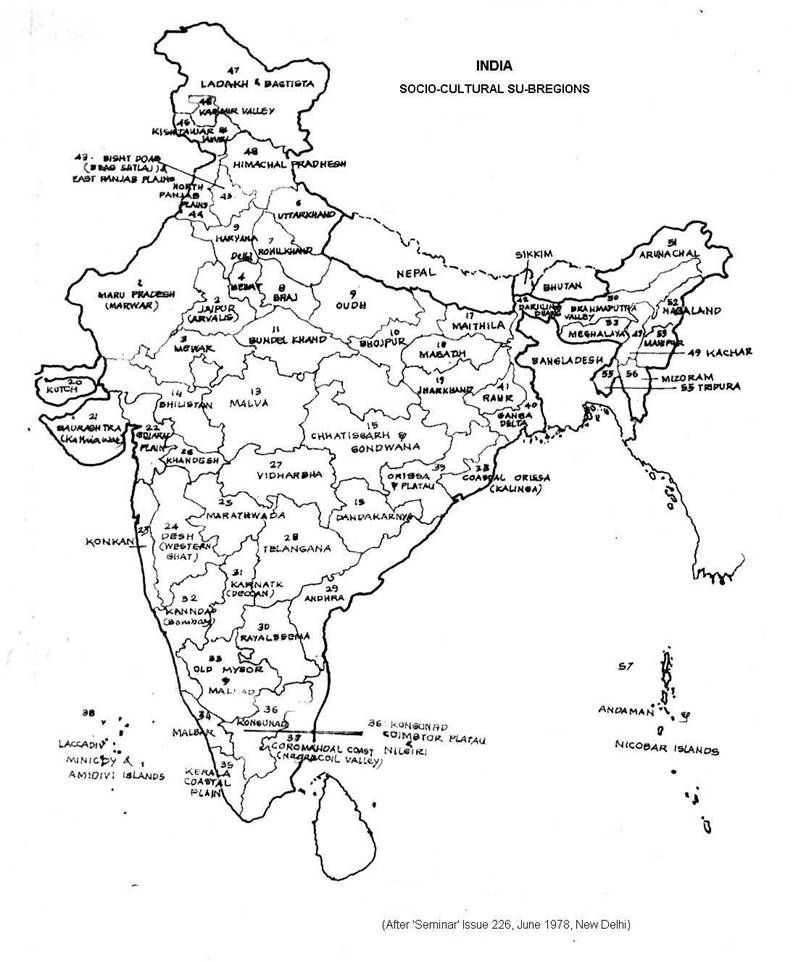
India: Socio-Cultural sub-regions
Restore Languages to restore People’s Autonomy. There are as many languages as the cultural groups.

THE COLLECTIVES of the aborigines or Adivasis are better addressed as 'communities'. Because their social formation is not based on division of labour, caste and class, like civilized societies. Here, every individual is representative of whole community. A notable feature: there is no prostitution among Adivasis!

THERE ARE some ethnic communities. For example, there is matriarchal ethnic community in Kerala. Before Aryans came, there was matriarchal society in Karnataka (Bharatiya Sanskritikosha, editor: Pundit Mahadevashastri Joshi). There are also communities of Laman or Banjara (Romano), Dhangar (shepherd) etc.
Distribution of some major tribes of India
Adivasis come with the wealth of their ancient wisdom. The loss of their Forest habitat means assault on their existence and survival.

INDIA STILL HAS RICH BIODIVERSITY; hence, there is rich cultural diversity. The culture is the gift of Srishti, ‘Mother Nature’, to humans! It is, therefore, necessary in India, to include the subject of anthropology in all branches of higher education. It is necessary for the elite to learn about plural society of India. History of India, introduced by the British, is too narrow, mean and out of right context. It propagates feudalism, which is not good for democratic values, than “People History”.

Institutions
THE COLONIAL RULE brought here industrialization from Europe. It dominated entire educated and illiterate society, before anyone realized. It was not a revolution; it was borrowing; it was imposed. Industrialization came, along came many institutions and complex laws. They took over the private and public life of the collective and an individual. And both lost their autonomy of self-decision and self-reliance.

Social Work
BECAUSE OF INHUMAN SOCIAL AND ECONOMIC INEQUALITY IN INDIA, many institutions, movements, activists… committed to social work started during past 100 years. However, we speak from a public platform; we take for granted what is below the platform, the reality that is constantly changing. We say 'Chalata Hai – This goes on,’. And the work that remains for the experts, professionals, politicians is to find "curative measures" to save their skin.

IS THE WORK of a teacher, doctor, technocrat, engineer, architect, Govt/semi-government-employee, city planner, economist, scientist... police not "social work"? Aren't they the part of society? Of course, in a decadent society — whether Western or Eastern — this may not happen. We, however, caress our ego. That's all!

NGOs
THERE ARE NGOs from UN at global level to countless numbers in the bye-lanes of Delhi-Mumbai... These social institutions are started with noble aims and objectives. Some work within their specialized fields. Some of them face resource crunch; they have to struggle to collect funds to survive. Some disappear in the blue. Some show feudal / bureaucratic traits. Some of those working in rural areas think of illiterate peasants and the tribal as backward and "uneducated", and they have come to educate them. These professional social workers from cities find nothing worth "learning" from them.

Education (Learning)
AT THE BEGINNING OF 20TH CENTURY – the times of Ranade-Gokhale – there were two percent educated (not literate) people. Gokhale then was struggling to bring a bill of 'free and compulsory primary education' for India in the Privy Council. That was hundred years ago!

EDUCATION – Learning and Teaching – is now an occupation, no more a vocation. Educational Institutions prepare the highly educated, professional, specialist etc. candidates for employment- business. But our Public Education Institution has failed to impart literacy to large number of people in the past sixty years. Isn't it the "State-at-misfortune"?

Social commitment
WHAT IS SOCIAL COMMITMENT and whom does it apply? To give the last rites to a dead body, according to that person's faith (if known), may rank at the top on the part of society. Just imagine: if the dead is not disposed off in time, what problem would it cause to the society!

BUT THE SOCIETY, religion or person/s need not worry about it. Srishti is does it by ‘recycling’ a dead body. Millions of worms will be born in the dead body and finish it, and they too die and turn into soil.

An ordinary example of social commitment
IN MUMBAI at our home, an illiterate woman of untouchable caste was our maidservant. Once she brought a dispossessed sick old man about to die, at her home – a hut on the roadside pavement. She nursed him. She also gave him the last rites after a couple of days. Honestly, I couldn't have done this.

Reunion with Mother Nature
Conservation of Nature
VINOBA BHAVE, in his commentary on Gita, spoke of three-fold Yoga Actions, Sacrifices –Yajna, gift and penance – as I recall.
1. Yajna (sacrifice): whatever we take from Nature we must return back, for example, we take food grains from land; therefore, we restore it by putting manure, watering etc. That is Conservation of Nature.
2. Gift: society, parents, guru, kin-kith etc help us in many ways. Give them gift in gratitude and to restore their losses (this is not charity).
3. Penance: we use our body – mind, intelligence, limbs – in daily actions. We must restore the loss of energy and remove impurities etc.
Society and our body are not outside of Nature. Similarly, these three actions are Yajnas, Sacrifices. (Ref: Gita-Pravachane, Chapter 17). This interpretation of “Social Commitment”, on the part of an individual and the collective, may sound non-conventional to the believers of Gita.

A PYRAMID, TAJ MAHAL... To build these artefacts does the money come from a government mint? All the wealth that humans use basically comes from the Earth. We only process it. However, all the living-beings have equal rights to the Earth. The artefacts mentioned above indicate 'feudalism' of persons, caste or class. Unfortunately today this is repeated even by democratic nations.

THE LAND IS NOT ANYONE'S PROPERTY. None, neither the State nor a person, has ethical, moral right to own land. In its history of 5000 years, how the civilized society mutilated this land!

DEMOCRATIC GOVERNMENT'S OBJECTIVE must be “Janata”, the People: only the People are "Means & Goal". All planning, projects, laws… their making and implementation processes should be guided and materialized through the People. Government and other institutions are only facilitators and accountable to Janata.

GOVERNMENT and other institutions are merely tools, faceless entities. Their primary duty is to the People, to protect their primary autonomous functions — Work, Leisure, Health, Learning and Propagation — and according to changing situation prepare development projects and make them available to the People.

Need for right education
"FOOD-SHELTER-CLOTHING are basic needs", a million times they – expert, planner, politician – must have chewed this old dry bone on the public platform! These celebrities royally forget a fact: Even animals have this knowledge by intuition.
Leisure - Children exercise their autonomy

Peasants and Adivasis don’t Need Entertainment / Leisure Industry.

SRISHTI, MOTHER NATURE, gave all the living beings — plants and animals — an ability and autonomy to fulfil their needs for survival. For this purpose she also provided them with five autonomous functions: Work, Leisure, Health, Learning and Propagation. Srishti, also, does not give any authority to manipulate over these functions to any human or supernatural power or institution.

THERE IS NO NEED TO REPEAT HISTORY time and again. History is before us by its litter everywhere. Question is, is there any remedy to the problems created by the history? Whether we correct root cause/s of mistakes, or find new technology, or carry on status quo policy to make superficial changes, or import a readymade foreign technology? What for creativity / originality then?

People-conservation and Social balance
INDIAN FARMERS continue to commit suicides. About 300 million people are bellow poverty line (BPL). There is no reliable count of how many are living in sub-human conditions in the slums in cities. In the 21st Century of Gregorian calendar, there are 400 million illiterate Indians in the Age of Computer-literacy. How could this 'Janata' face the forthcoming annihilation from 'technocracy'?

Learning by Sharing
The urchins here give a Fundamental Lesson in Learning. By this indigenous method the whole India will be literate in five years. People's Need is Access to Resources.
New Education for Six Lakhs Villages
HOW TO DECIDE WHAT IS RIGHT EDUCATION FOR 900 PLUS MILLION PEASANTS? Who should be given priority, between Industry and Trade (organised sector), and peasants (unorganized sector)? About 90 crore people (not population) live in six lakhs villages. Which institution or media can give reliable facts about their despair in areas of food, water, education, health, agro-produce... and income? For this reason “Decentralization of Power” is an urgent need.

PREVAILING EDUCATION SYSTEM is being run for 60 years by making superficial adjustments time to time. There is no fundamental change. To bring a change following points must be attended and documented in details.

Survey of local conditions in six lakhs villages
THE SURVEY must be carried with villagers' participation at local level. Such a survey, not only becomes a part of people's education, but there is essential transparency. This must not be a sample surveys done by statisticians. The Census Surveys are insufficient.
1. Environment: natural, social, economic, educational, political etc. all aspects of environment;
2. Ecology: local language and vernacular, and their mnemonic knowledge, folk arts, the life-supporting skills in practice, traditional knowledge and tools used for living;
3. Energy: Climate, human-energy, animal-energy, bio-energy, mineral wealth, plant wealth, such as food, plants for oil-insecticide-medicine-aroma-building-colours & dyes-fibres-spices & condiments etc. Plants from land and waters, from algae-grasses to vines to giant trees;
4. Geography: location and regional linkages

Subjects for Rural Education
SUBJECTS AND TOPICS should cover all related areas that influence, affect, help that are relevant in the present situation of villages.
1. Water and land conservation, Farming & related topics, Animal husbandry, Biotechnology: (Remember that rice was domesticated 10,000 years ago, when civilised societies, cities, nations, and the word, biotechnology did not then exist.)
2. Development of Alternative Energy Sources that are used by the peasants, marketing, commerce;
3. Local self-government, land revenue, Land Acquisitions Act(?) etc. related laws;
4. This education should have field orientation;
5. Access to young and adult of all ages, genders, timings & batches suitable for peasants.
Buildings – Schools buildings – should be built in local vernacular technologies, using local materials, maintained and repaired by the locals, and not by the Public Works Departments (PWD) or third party such as contractors.

Epilogue
HOW MANY OF OUR 'CITIZENS', though they may have migrated from rural area in the past, know intimately any 'village' and its ‘Janata’? Many may be well versed in world geography, yet their personal world remains flat – two dimensional. The Sun and the Moon, however, move tirelessly around the Earth and meet each of our godforsaken villages, day and night.

THE VILLAGES must have their rightful share of resources of the nation. Their major stumbling block is education. If this is not restored to the People, the so-called 'progress', praised by others, mostly by the vested interests, may prove merely a 'pseudo-progress'.
* * *
Related Posts
1. Politics of Literacy in India : Challenges of 21st Century
2. Farming: Politics of Education in India
3. Letters and Numbers, plus ‘Things to Make'
4. Work-Leisure-Health-Learning-Propagation

© 2011 Remigius de Souza | Mumbai

 ~ ~ ~ ~ ~
©Remigius de Souza, all rights reserved.

Wednesday, 21 September 2011

Seeds of Hybrid-Cultured Mass Society

Seeds of Hybrid-Cultured Mass Society

Hybrid seeds of food-grains came much later. 
By then industrialization had successfully bred the hybrid culture through the assembly lines of mass education to produce mass society in the First World Nations, now named the (virtual) Global Village.

The result: "hybrid culture of mass society" who have no posterity ― no community, like hybrid seeds that have no second/third generation crop. 
Peasants must buy seeds for next crop from the markets. 
The culture of mass society characterizes its loss of autonomy to think and act on their own; now it is decided by the visible/invisible rulers.

No wonder, for the likes of the Gandhi, the Schumacher, the Thoreau… there are no takers on the assembly lines: no germination, no posterity.
They rest in peace in the archives, except for occasional ‘quotes’ in discourses by pundits and politicians.
They are already a part of the past, like socialism, radical humanism, modern, post-modern, Art Nouveau… but no action.

"Hybrid Culture of Mass Society" ia a milestone in the five thousand year old history of Civilized Society!

(04.07.05)

~ ~ ~ ~ ~ 
©Remigius de Souza, all rights reserved.

Monday, 11 April 2011

Indian Schooling

In the year 1947 India's population was about 400 millions, and 60% to 70% persons were illiterate. Presently there are 400 millions illiterate persons. What at the beginning of 20th century G. K. Gokhale attempted, to bring 'free and compulsory education to all, is still not fulfilled.


Indian Schooling

I HAD AN OPPORTUNITY to watch a short play on Door Darshan (DD), India's State TV channel, on 21-09-1989, in the afternoon transmission. It was on the occasion of International Year of Literacy. The play was about schooling. Now I, sort of, admire its main actors, Sulabha Deshpande and A. K. Hangal. I consider them to be respectable artists in the Indian cinema, TV and theater.

The play is obviously propaganda for the good cause of the spread of education by schooling. In the play an old lady (Sulabha Deshpande) wants the little boy to go to school so that he does not remain stupid like her old man (A. K. Hangal).

The boy looks after the goats and does not want to go to school. At last the old lady sells the goats. But the boy is upset. He refuses to go to school. He even attacks the other boys who come to take him bodily to school.

I wondered if Hangal and Sulabha pondered for a while over the treatment of the theme!
Here the goats are projected as the pets in the affluent families like pedigree dogs, horses, cats etc. For a villager a goat, cow, buffalo or hen is a means of livelihood.

Why then is the old man said to be stupid? Is it because he is poor? He is poor perhaps because he has been exploited first by British rulers and now by the industrialized society in India?

Why is schooling so important that one should give up the very means of livelihood – goats? Why is the rearing of animal so inferior? (Well. Some people consider that the goat is an enemy of forestation. Forestation means left over — whatever that is left after modern man — has eaten away the forest. Otherwise the goat is a sturdy animal which can live in the deserts as well as mountains, in hot as well as cold climate and is most economical to maintain for the poor. Its milk is medicinal.)

I wondered, couldn’t a goat, a tree, a paddy field, the making of an earthen pot, or moving of a plough in the field be part of schooling in India?

Why can’t actual cooking or preparing food, treating the sick, growing a kitchen garden, Milking a goat or a cow (the method of milking is different for each of these animals), making a toilet, urinal, treating garbage in the village, potatoes and onions, water and washing, sand dunes and ravines, cyclones and floods be part of schooling — actually, not merely verbally — not merely on the blackboard — either inside or outside the school building?

But the system the British started is so powerful that there is not much change except in nomenclature and timings.The so-called educationalists are still in the grip of the system started by the British. The play that was shown on DD is typical of the way the educated, the urban elite project schooling and education.

What if 5.57 lakhs of villages in India gave up rearing animals?

What if every family of 557 thousand households brings up graduates, masters and doctorates? Then, perhaps, those sitting in the chairs will lose the power game, of musical chairs; they play with lives of poor people. Finally, what is the relevance of present day English-made schooling in the eyes of these villages where 70% of the population is still illiterate?

This English-made system of education has not much changed since it started in this vast country made up of villages having a variety of landscapes, regions, climates, dresses, tongues, topography.

I take a little time off to ponder meanwhile this ‘natak’ (play or Tamasha) of Door Darshan brings insult and humiliation to realities of living in an Indian village!

For further reading: 1. Politics of Literacy in India; 2. Farming and the Politics of Education in India; 3. One Step Quantum Jump in Education; 4. Letters and Numbers, plus ‘Things to Make': Restructuring (Indian) Education 

Note: After twenty years I find this note is still valid. It has not changed the situation other than few numbers, while the population is growing. I republish it.

[Published in (1) GOGRAS, publishers Akhil Bharat Krishi Goseva Sangh, Vardha, India 442001, March 1990, year 14, issue 5, p. 236-7; (2) FOURTH WORLD REVIEW, Issue 44, p 14, The Close, 26 High Street, Purton, Wiltshire SN5 9AE, UK. 1990]
 ~ ~ ~ ~ ~
©Remigius de Souza, all rights reserved.

Saturday, 19 March 2011

India, Bharat or Gondwana


India, Bharat, Hindustan, Aryavart, Tamilnadu, Malaydesh, Kalinga or Gondwana?
 
Ill. 1: Bhill children at Holi festival in Satpuda Ranges, Gujarat
Bhill aborigines in India do not use their thumb in archery to this date. 
Call this a living memorial of Ekalavya, or unwritten history.
Cult of Tree Worship and Holi Festival are animistic customs from antiquity. 
Other societies adopted them with different meanings and/or reference. 
Bhill's Holi Festival is unique.  

After our Independence there was debate on what should be the name of our nation; I read somewhere. Now I don’t remember particulars. In that discussion, it was impossible for 'Gondwana' to appear, even by accident. However, anyone uses any of the names, India, Bharat or Hindustan, according to one’s convenience/occasion.

Why did the wise citizens, leaders, historians etc. accept two names, India and Bharat? I fail to solve this puzzle, and I don't know what options they had. Perhaps this information is in government vaults under lock and key!

Word ‘India’ comes perhaps from 'Hind'. The Persian word 'Hindu' is derived from River 'Sindhu'. However, 'Bharat' is not a translation of 'India'. But why two names? Is this a sign of two minds or deceptive policy or inferiority complex?

Our neighbour Sri Lanka, a small nation, was also a British colony. But they had no difficulty to push the name 'Ceylon' away. East Bengal pushed aside 'East Pakistan' and by taking 'Bangladesh' preserved their identity.

Why then did we get stuck? In reality, we are very much in need of, and fond of, certificates from others, especially from the white people. And also we are fond of names (hero worship), to change names, also to call names!

However the name 'India' might have been continued as a memorial of our political and intellectual slavery. It is possible, if we see our craving for imported foreign goods that is visible after Independence. What to do? We also do very much love history or the Past!

I was going through a Marathi book on linguistics. Its basis was Marathi is Aryan language and it evolved from Sanskrit to Prakrit to Marathi. (I think the book is based on this hypothesis.)

Ill. 2. Social and Cultural sub-groups in India
However, were there no languages in this country before Aryans came? Were not there other cultures and societies / communities? It is not mentioned in the book. As it is on linguistics of Marathi, there may be some limitations. Even then this missing reference is felt.

Something similar might have happened while deciding the name of our nation! They might have missed the context to the diversity of country's history, geography, society and culture etc. Whole attention may have emotionally been moving around Aryan culture!

Naming a Nation needs dedicated handling. Basically the British brought the scattered States and regions together and gave it a shape of a 'nation'. It should also be kept in mind that by this time the disciplines of archaeology and anthropology were well established.

Ill. 3: India in Vedic times (author unknown)
In Persian the region north of Vindhya ranges was named 'Hindustan.

The word 'Hindu' itself is Persian, derived from name of river Sindhu. Indus Civilization existed around river Sindhu. That civilization vanished, but people survived. Great empires / civilizations vanish, but 'ordinary' people prevail.

This is a simple lesson of history. God may be merciful, but Srishti - Mother Nature - is ruthless. Otherwise where are Aryans and Vedic culture today? Whatever culture is visible around today is probably a parody or adulteration or caricature?

Before Aryans came here there were Indus Civilization, Dravidians, and even long before them there were Aborigine communities. The aborigines had languages and cultures, and they do have even today.

Truly ever since Homo sapiens came in existence they received the gifts of language and culture from Srishti - Mother Nature. And they also received wisdom to change or transform their 'way of living' according to the state of place-time-environment.

All the aborigines of the world have their ‘way of life’ attuned to Nature. In other words: This is ‘religiousness’ imbibed in their body-mind-conscious for millennia; this is vocation (Sahajadharma); this is not a 'religion' or ‘magic’ that civilized societies are used to, or do understand.

Therefore, despite several and different assaults upon the aborigines by civilized societies time to time, those who survived annihilation, they continue to sustain until now. Living in natural environment, they are not in proto-historic state. However, having gone through the test time their 'will to live sanely' is extraordinary and steadfast.

But to deprive Adivasis – aborigines – of their natural habitat and environment by taking away or destroying it means to kill Adivasis; it amounts to annihilation even if they are kept physically alive.

It may be acceptable to the State by the prevailing laws, but it is not 'justice'. To impose civilized 'life-style' is injustice; their conversions to other faiths or dogmas are religious atrocity or blasphemy! There are no superior or inferior cultures.

In the Law of Srishti – Mother Nature – there is no room or regard for civilized orthodoxy. Moreover there is no place at all for any hierarchies created by humans in the realms of Mother Nature. Such civilizations are lost in the past. History is the witness. This is well established by the recent tsunami that hit Japan.

Historians, while writing history, have several subjective and objective constraints / limitations. History, however, by its residue – by-products – of its contemporary cause and effect, means-goals, is always / constantly present before us, and also within us by mimesis. One must have ability to read it with courage and impartiality.

During geological time, there are constant movement /upheaval in the Earth. But they may not necessarily be visible. In the history of Earth a super-continent separated into five pieces and spread out across oceans. They are present South America, Australia, India, Africa and Antarctica. But India then in the super-continent was not the same as is today; it was only the southern part of Deccan Plateau. Himalayas and North India did not exist then.
Ill. 4: Gondwana in the History of Earth (Source: scotese.com)

Eduard Suess [1831-1914], Austrian geologist did put forward the idea of super-continent (1861 A.D.) and named it 'Gondwanaland'.

Gondwana situates in central India, where Gond aborigine tribes live since unknown times. Even now there is (?) thick forest. Eduard Suess had no vested interest in India, Gondwana or Gond people. Indeed he was a world citizen.

Ill. 5: Map of Central Provinces (1903 AD) shows Gondwana


As civilized societies took over their habitat 
the Adivasis retreated in the remaining forests. 
A known eaxapmle is destruction of Khandav Wana in Mahabharata. 
Ill. 6: The British time map shows Gondwana in Central Province
 The British Map shows ‘Gondwana, but India/Bharat fails.

However, present Indian maps don't even mention the name of the unique region. Isn't this enough reason to show how mean and racist the present Indian rulers are?

While declaring 'secular state' on one side, how modern India, or 'the first world India', continues their Aryan racism is evident from this example! By ignoring their historical presence, the Govt. has eliminated the presence of entire Adivasi – aborigine – world, The Fourth World India!

In the Constitution of India there are these words, “India, that is Bharat”. (I am an ordinary citizen, and not an authority on constitutional matters.) By now, I understand, there have been about ninety-four amendments to the Constitution. Hundred years ago the British made a draconian law, 'Land Acquisition Act', which had been amended only about ten times. Now, we hear, it is being rewritten, anew?

Indian Republic has now passed 60 years. Though late, at least Supreme Court of India has awakened to acknowledge presences of Adivasis. On January 12, 2011 the SC of India gave an important verdict in reference to Adivasis – aborigines – of India, which reaches the first and decisive step.
(See link: India, largely a country of immigrants says Supreme Court of India
< http://remidesouza.blogspot.com/2011/02/india-largely-country-of-immigrants.html >) 

So far, this work is done by the 'Govt-the-Judiciary' of the Govt. of India. Now the work that remains is for the 'Govt-the-Lawmaker' and the 'Govt-the-Executive' to do. This is harder task to do.

It is harder because to remove or to break a 'mind block' is not an easy task. Boundaries of continents change; courses of rivers change; mountains erupt where there are plains; sea shores change; borders of nation change; once a super power USSR gets dissolved. What is in a name?

Beginning with the name, what historical errors Independent India / Bharat has been making? Whatever errors, they must be corrected. Then present errors in making / future errors could be avoided. This action certainly makes long range effects on national and international levels. For example, there may be resistance from the partisan Orthodox / vested interests, as well as new directions to thinking, and the honour of the nation will scale Himalayan heights.

Eduard has already introduced the meaningful historical name 'Gondwana' 150 years ago by naming the super continent. It refers to ancient 'aborigine peoples' and 'forests' on the Earth (Both are vanishing because of assaults and annihilation by the powerful civilized societies). Now only stamps of amendment procedures to the Constitution remain!

Gondwana: 'Gond' stands for, beyond the particular, all aborigines and also wandering – gypsy, Laman, Banjara, Romano, shepherd etc. – communities of the World who hail from ancient times. 'Wana' represents Forests, tree cover, natural / organic 'Agri-Aqua-Horti-culture' farming, but not mechanised-industrial farming.

From here onwards begins the chain of corrections of material and moral errors in the practices and policies. It also must begin with writing (or re-writing?) new textbooks on history, geography, civics, sociology, economics, politics, commerce, and other subjects, for the old and young generations.

Millions Unemployed people – the educated and the literate-illiterate – will get 'work' for this action in all regions; because the primary sources are the People. Hundreds of languages will get “scripts” and bring literacy that has been languishing for ages. This is more down to earth ‘urgent need’ and 'less costly' then sending a spacecraft in the sky.

'Lotus', the national flower, the seat of mythical Sarasvati, will then truly bear a thousand petals. May it symbolize the control over destruction of plants and forests; may the Adivasis and peasants, instead of just hearing words of promises, see in reality the days of 'plenty full water,  plenty full fruits' – Sujalam Suphalam – hopefully!

Remigius de Souza | Mumbai | Holi: 19-03-2011.

Note:
1. This post is translation from the original Marathi post published on author's blog Remichi Marathi Boli.
2. Illstration 1. Photograph of Bhill children was clicked 40 years ago by the author.
3. Illustration 2. Social and cultural sub-groups of India, after the cover page of 'Seminar', Issue 226, 1978, New Delhi.
4. Sources of other illustrations: Internet.  
~ ~ ~ ~ ~
©Remigius de Souza, all rights reserved.

Tuesday, 7 September 2010

All Are Architects

Honeybees and Hive
 ALL ARE ARCHITECTS: Honeybees are architects; Spiders are architects; Weaver-birds are architects; Beavers are architects; Ants are architects... 

All are architects, because at primary level architecture is Shelter; that matters! The Title 'Architect' is protected by law in some countries, and following them in the First World India. This is so because of ignorance about real life and real issues of people.

However, thankfully, the term “architecture” is not legal.

In India now there may be about 50,000, perhaps more, qualified architects. How many of them have taken legal title is doubtful. Imagine, 1200 million people have 50K architects! They will have no time to cope up the amount of work they should have had. 


Weaver Bird's two nests are never same

Spider's Site Selection

Yet there is monopoly of a few architects in the profession. Forty years ago, one architect, a foreigner of credibility, (I don't mention the name) exclaimed in Ahmadabad, "these mafia architects!"    

While “shelter”, howsoever may have stood the test of time, is considered “low” in esteem by civil society; “Architecture” is “high art” surrounded by mystery. In the present scenario, “architect” belongs to a “service class” – in Indic term, “Neo-Shudra” – in the created by Industrial Civilization, on the outskirts of Global village.   


Anthills
 Well, that was a case earlier too. Emperor Shah Jahan cut off the hand of the architect who created Taj Mahal! 

Heinrich Robert Zimmer, in his book on Indian art (Myths and Symbols in Indian Art and Civilization), quotes a story of the gods’ architect, Vishwakarma, who had built a palace of Indra, the king of gods. Indra brought him virtually to tears. So he approached Vishnu, and he took Vishvakarma to Shiva for recourse. Shiva, in a guise of an ascetic, gives Indra a vision to understand that his glory is short-lived like a millions Indra that have passed away before him. The mythical story imbibes aesthetics and ethics. 


MY HOUSE IN KONKAN REGION, WEST COAST, INDIA 


My mother was the owner - architect of this house. It was built by Community Participation, where carpenters, masons, adobe wall builders came from village and surrounding area. I was in teens then. I took by first lessons 'mud house building' here.My mother exercised her autonomy about planning, size, materials to be used, in consultation with all workers: it is in regional style. This house was built by self-help.

It is a mud house - mud floor, mud walls and mud plaster; local latarite stone facia for plinth, and pillars; timber for pillars, bamboo for roof scantling, wooden doors and windows; and country clay roofing tiles. 

I worked almost in all operations as a helper, from collecting stones, and from foundations to roofing, and later regularly attended to maintenance of mud floors, mud walls and roofing. This is a case study: All over India millions of people exercise self-help, autonomy, community participation, planning, maintenance and economy. 

In rural India children learn 'life-supporting-skills' at early formative age. May the elite scorn it as "child-labour", while pampering their urban rich brats by putting them in the best school in the city or a best in the country... What contribution the parents do other than spending money! Modern India has failed to create better model of education than  that has been existing in the past ten thousand years, in past six decades.


NOTE: 1. Images are by Remigius de Souza. 
~ ~ ~ ~ ~ 
© Remigius de Souza, all rights reserved.