Showing posts with label Art. Show all posts

Wednesday, 28 November 2012

CRITIQUE of CREATIVITY


In Communion with Mother Nature

Constructive Criticism


Mainspring of Creativity 


Creativity: We generally attribute this action to the expressions of various arts. However, the basic force of creativity is only to conserve life. From conception of life to feed a baby and the innumerable actions onwards that follow are the parts of the creativity. Because of our mechanical way of living, we are not conscious; that's all.
Bhill youth playing bamboo flute
Bhills make their bamboo flutes by themselves. Its history indeed goes back to millennia.

2. Ancient bone flute (30,000 yBP)

 The bird bone flute was found (in 2009) by the archaeologists. It has five holes.
Interestingly Bhills too use five holes to their bamboo flutes.


Constructive Criticism


I learnt what may be called constructive criticism/critique from Anand K. Coomaraswamy. It was useful in many ways. Mainly, I left subjective reaction and moved to objective response to any event.

By the study of environment, which is the very foundation of “shelter” or architecture, I could go beyond personal and societal spheres.

My beloved Tukaram has major share in making me understand ecology: “plants vines wildlife (are) our kin”. To understand this mantra, came to help my physical labour and community participation in the fields of paddy - vegetable farming and cooking, mud house building, and cotton spinning and weaving (this under Gandhi's Basic Education) during childhood at my native village.

While learning architecture I came to understand how vary many rooms in buildings are interdependent in their planning. If a room or an element is shifted, changed or removed, the whole schema is affected. Hence it needs reworking.

Tukaram's five words also reveal how environment, ecology and energy (EEE) fields are interlinked. It helps if we meditate on simple looking work such as farming, cooking or shelter etc. to understand how the three – EEE – are interlinked and interdependent in the Nature.

This path is as much abiding and arduous that much joyous. No shortcut. No books. Only field work helps.

AK Coomaraswamy died in 1947 after Independence of India. From this time onward the change that came with British Raj accelerated in India.

The change was taking place in almost every sphere of life at large. It has affected most the majority i.e. agrarian society. Their rehabilitation should have been taken up on priority basis as soon as the British left.

The root cause perhaps is the development in Science and Technology by the turn of the last century in India. It has been taking place all over the world. The west, however, grew along with this change from the rise of Mechanical-Industrial Revolution; while in India it was imposed.

In 65 years we have not grown 'up'; we have only grown 'old', and culturally we tend to respect 'old' age - man or stone.

Indeed the change (which we tend to call 'development' is a misnomer) affected the primary needs: food-shelter-clothing and natural autonomous functions of all living beings: work-leisure-health-learning-propagation, not only in human world, but all living-beings in land-water-air across the world.

When these fundamentals are affected, then what about social, political, religious... blah, blah, blah institutions or Heaven and Hell?

Needs in Wanting Constructive Creativity


When we watch now the TV channels 24/7 throughout year that show us buttery love and marriage stories combined with crime and violence, with innovations aplenty, as if none else exists to entertain us, or rather to Think about.

In Mumbai, for example, about 200-300 movies are produced annually. But at what cost of resources, at what environment-ecology-energy cost, for what except passive entertainment, and for what social ends?

Presently millions of Indian ryot are going through crises of survival facing a billion problems of food, water, work, health, literacy, shelter etc. and scarcity of resources due to lack of equitable distribution. Who is going to answer them? Is it Government, Parliament, a trillion Rupee Bollywood-Tellywood entertainment industry, stock market, or economy?
Only ryot can answer these questions. 

For any planning, project, or progress, 'Ryot is the Means and the goal'.

Constructive Criticism raises the issues or context missed in the schema of any event, not only literary work, and comes up with relevant suggestions in larger interests.

Purpose of Art


Art takes place as self expression at any age or in times. Art has no definition. Civil Society may have put art in many divisions, trends or schools etc., but they are superficial.

One may express self in a spontaneous dance, song, scribble in soil, scratch or draw on a wall, make a clay toy, or tell a tale...

Civil society is fond of divisions, grades, castes or classes and hierarchies. Hence it deviates from the essentials. So let us ignore all that nonsense.

Art as self expression comes from experience of reality and emotions. The reality could be Nature, Natural phenomena, other beings - persons, plants, animals... and experience of emotions out of these relationships.

Art transfers energy created from emotions in a creative work, which arrests Entropy. It could otherwise cause mental or physical malady. Art is not a prerogative of the professional or a class.

Community Participation: Paddy farming in Konkan | Image by Pooja Rani
Farming is not recognised by the elite society, though it uses the canvas of land, works in harmony with the Five Elements, fulfills the mainspring of creative art.

Incidentally, Indian tradition recognized 64 arts, which have been life supportive, for society as well as a person and family. My favourite claim is that Farming is the highest art form, which of course, the high culture of civilized society does not support. This is obvious because of its vested interests in the centralized power rested in higher castes/classes.

Purpose of Science


'Life', too, like ‘Art’, is not defined, not even by sciences, though there are dictionary meanings. We, however, understand what Life is (by death of a being that ends 'it' in an inert matter?).

‘God’ concept possibly came from extreme natural phenomena (in the remote aborigine past) to express their power in graphics and rituals.

Scientists, now, may call it a 'God particle' - whatever they claim to have discovered. It is not Truth. The Mystery of Nature continues to deepen!

Science works with analysis, whereas, Art is synthesis, in the civil society. This division did not exist once upon a time when fire, lever, flute, bow and arrow, pottery etc. were discovered.  Art, science or technology, whatever we may call, then, was for the well-being of the people.

There was a time when art, science and technology were not separated, just as now the line between science and technology is diluted because of vested interests in economy.

Critique of Creativity


Creativity for Everyone

 The true purpose of art, science, technology, other disciplines, and also the institutions is the welfare of, not only people, but also of the ‘Other’ (humans) and all the living-beings and their habitat.

Constructive Critique should be levelled at not only art and its various divisions, but also other disciplines, public and private institutions, at a street level. They should be subjected to the Justice by Peoples' Audit, not by courts of law: Justice is above the laws of the State.

Creativity is a buzzword now. It is applied to, from arts to sciences, warheads, engineering, ET-IT, commerce, politics... Almost everything in one go, which comes under the purview of market and consumerism, whosoever their godfathers are, sitting in their plush boardrooms!

However, the quality of creative object is hardly discerned; whether it is constructive or destructive, keeping in mind the 'Other' humans and all other living-beings and their habitat, their dependence on the natural environment, ecology and energy. Keeping in mind the present fast changing scenario, we cannot remain in our protective shells! Remember Tibet!!

It is crucial to look up at Constructive/Destructive Creativity, not in the compartments made by the so called experts, but in the Holistic way of Mother Nature, where no departments exist.

NOTES:
1. Please see the paragraph - Indian Architectural Terms, Essays in early Indian architecture (Book Review)
2. Image 2, Ancient bone flute (30,000 yBP). Image source: New York Times, Flutes Offer Clues to Stone-Age Music.
~ ~ ~ ~ ~
©Remigius de Souza, all rights reserved.

Monday, 25 June 2012

The Youth in Life and Letters Now

 The Youth in Life and Letters Now

“The full potential of human creativity has not yet been tapped. Along with the ever-increasing miracle of love, this fact is one of the brightest hopes for human race” (Ben Okri, ‘A way of Being Free’, 1999, P.28)
Srishtiyoga - Way of Mother Nature

ACADEMIC year is about to begin: This issue is faced by a particular segment of 1200 plus million people. For the other segment of Indian society faces how to make both ends meet: their daily bread.

The elite youth (m/f) are now carrier-oriented (seeking affluence). They go through grading (degrading), reward (punishment), competition, pampering, pressures, info bombardment... blah, blah, blah.

EDUCATION is groomed to serve Industrial Society. Advent of Industrial Society brought break up of existing i.e. pre-Industrial Society, then came the breakup of family; now break up of nuclear family. (Check no. of divorce cases in family courts at metro cities.)

But this education has no social (read life supportive) orientation. Hence numbers of institutions (expertise) flourish to take over our personal and societal domain to solve our problems, which replaced the elders (put away in the homes for the aged). The result is present Mass Society that faces Identity Crisis.

WE, therefore, want to establish and/or assert our individuality or identity, where and when possible (e.g. in social networks, or looking for life partner on Internet), and even within family!

What is forgotten by the expertise is that human being is a dynamic entity. Hence generalizations fail: such as horoscopes/zodiac signs! Each individual is a unique entity. Humans cannot be graded like apples in the market place. Only awakening of their constructive creativity is in want.

India now is a picture of 'Culture of Contentment' and the Disparity turning into Despair; plurality turning to polarity; the powerful few seeking more power and the poor majority grows with their rising population by Nature's Unwritten Law of Survival of Species.

The million petal Lotus of Indic Culture turning to disintegrated Mass of the Collective, living either in the bygone Past or in speculation i.e. Future.

There is a silent war going on but without a bang. Who does notice it?

Nature knows no borders imposed by Civil Society


Iraq's oil wells were bombarded by Iran, during the war between the two. The soot from burning oil drifted by wind and settled over icy peaks of Himalayas. The black snow melted and came down to Sukhna Lake at Chandigarh. This was minor news.

Nature does not recognize borders of sovereign states, or exchange rates of international currencies, social hierarchies created by civilized societies.

What are our priorities when Life is at stake? Everything in Nature is coordinated and interdependent. Nothing is isolated in various departments. 'Butterfly created a storm' - as a saying goes!

Universal Art for Living


Eight Hours, poster © Ricardo Levins Morales
Let us spare some time for meditation!

Could art of living, or any art, and ambition go ever together? Ambition is for politicians. Laws and acts cannot regulate or control, or even take responsibility of life.

Theories don't create art. Art is transient, beyond space-time. Once done, it is over. In the act of doing there is meditation, discovery, joy, and the very act is the reward. Such an act reaches the state of vocation.

Preparing the canvas of soil, sowing seeds, caring the saplings, harvest as and when, and it is over. Then start to prepare the great canvas again. A farmer works in direct physical contact with Elements – Earth, Water, Fire (Light), Air and Space. Farmer's action, therefore, reaches the level of vocation in creative thinking and action. This vocation is Art for Living that is synonymous to Art of Living! Cooking too is similar ancient art form. When each of seven billion people need reach to 'the full potential of human creativity'.

Life, with all its five autonomous functions -- Work, Leisure, Health, Learning and Propagation -- is provided by Mother Nature to all the life forms, for its sustenance. This happened even before all the gods created by humans: Believe it or not. 

Or ask bacteria, algae, humble grasses, happy grasshoppers, bees and butterflies. But we neither understand their language nor do we ever watch them. Hence we don't know how they sustain.

Better ask ourselves, until the end of our logic. Better that our logic dies by rigorous labour before we die!

Read more SRISHTIYOGA or The Way of Nature
~ ~ ~ ~ ~
©Remigius de Souza, all rights reserved.

Monday, 11 July 2011

'Tentacles' of Octopus Remi: Art in Metafiction

'Tentacles' of Octopus Remi: Art in Metafiction
By Remigius de Souza

"Srishti – Mother Nature – has Plenty to share; Nothing for sell; Nothing to buy. That is 'Reunion with Mother Nature' – Srishtiyoga." (SRISHTIYOGA July 7, 2011)

‘Tentacles’ | Remigius de Souza| 1987 | water colour or paper

Octopus Paul the Predictor one day suddenly came in limelight.

What was the cause? It predicted results of the World Cup 2010. That took the First World Nations by storm.

Twitter was crowded by twits that blocked the site for few hours! Such a craze... blind faith! That too from so-called advance societies! Amazing!

A European nation was even ready to buy that animal.

'Tentacles', Remigius de Souza's self-portrait, was published on Net but none was moved. Not even his friends!

Remi generally doesn't look into mirror. Because he notices 'octopus' in the mirror! What then could be his misery while wandering the streets of Mumbai metropolis?

He notices millions of people (his aborigine and peasant kinfolks) in the glass-clad multi-storied buildings mushrooming in the concrete jungle. But that never stops Mumbai!

Octopus Paul was a baby, lost to its community and natural habitat. After a few months it died. Relieved!

Did anyone ask Octopus Paul the predictor before it died, "When will this modern Industrial Civilization, which has become powerful within few centuries, vanish?" We have not heard.

Oh, what do you ask! The very strength of the powerful is their weakest point. There is a mythological Indian story of Bhasmasur that repeats again and again.

In reality the mighty industrial society has gone — if not dead, decayed — with the octopus.
 
In this self-portrait, 'Tentacles', Remi notices himself swallowing Natural Environment by his tentacles spreading and reaching across regions far and wide.

Call it his misfortune or his fate of unwanted share, or call it a ruthless criticism on Industrial Civilization. Words, images, movies, myths, scriptures, prophets, avatars... all tools to earn (power and profit) and/or entertainment! Does it make any difference?

Remi, however, laughs at himself at his cost.

NOTE: 1. As we write this post, there comes news about, Shuttle Atlantis docks with space station for last time! What a relief for the hungry masses of the world!! Better late than never!!!
2. Remi doesn’t watch cricket, hokey, football or such events as well as Olympics, World Cup etc. for he believes that any game must be played for leisure, and such mass events consolidate the centralized powers.
3. I have corrected some errors and edited this post. I request the subscribers to please bear with me. Thanks!


Mumbai Metropolis on Google Map

View Larger Map


~ ~ ~ ~ ~
©Remigius de Souza, all rights reserved.

Monday, 16 May 2011

Indian Farmers' Woes and Joys


Key Word: Art, Farming (i.e. Agriculture, Aquaculture and Horticulture (forestry) collectively or separate)

Five Elements
Traditional farmers’ lives that depend on monsoon are almost identical in many regions of the world. Hence the following text is inclusive.

Very few would ever believe farmers are artists. Farmers' art is most risky vocation, among all types of occupations, professions and vocations. Even a few may not understand this fact though they may know what is farming.
Haiku by Remigius de Souza
Farmer's art takes place on real field down to earth. Like in words, painting, photography etc. it does not create virtual reality. Farmers take the colours from Mother Nature - Srishti, of five elements, Earth, Water, Fire, Air and Space, and on a canvas of small or big plot of land; he works with contemplation. They are never verbose. They are fully in contact with every nook and corner of their farm; likewise the health of all the plants.
Haiku by Remigius de Souza
Farmers are not only artists, they are also planners, but not like town planners, who flatten the lakes and land, and cut it into pieces, make their 2D drawings to build 3D art of cities. Farmers use undulating land for management and conservation of water and land.
Poem by Remigius de Souza
Farmers are management experts, too! They manage land, water, seeds, fodder, weeding, manure, tools, carting, storage, other food crops, rearing animals and birds. And equally important are the repairs, maintenance, examination, improvement and policy planning in every aspect of home and farm, which is part of their homestead. All of these, they do within available resources. Many farmers may be ill-literate but are not 'un-educated' as the elite think.
Poem by Remigius de Souza
Traditional sculptors, for years, make Ganesha, Durga idols in clay. They are aware the deities are to be immersed. Yet they work with devotion, faith, without boredom. Farmers too work with same dedication. Their labour of love, therefore, is elevated to the status of 'vocation', of art. In their karma there is element of contemplation – Dhyan – hence it is 'spiritual' too. Traditional farming also involves action by Community Participation.
Haiku by Remgius de Souza
Politicians are like white clouds.
The educated elite class have an impression that farmers work only four months (during the season) and the rest of year lazy around. Even the experts like Amartya Sen are not exception. What about the governments and bureaucrats?
Haiku by Remigius de Souza | Image by Soojung Cho
More than natural calamities, the real cause of farmers' woes and miseries are the government and bureaucracy, market and industry, and their wrong priorities of progress and development.

Note: There is lot to learn from farmers:
1. Watering the farms: Learning from the people. Governments could learn how to save resources, particularly currency spent for development, and seal its draining at the bureaucratic level - the starting point, which consumes its major part.
2. Cow dung, Rice and Amartya Sen (a critique):Challenges of 21st Century
3. SEE: Soojung Cho’s Artworks of Inner Vision (http://www.soojungcho.com/home.htm )
~ ~ ~ ~ ~ 
©Remigius de Souza, all rights reserved.

Friday, 22 April 2011

Minimal, Minimalist, Minimalism Defined


Key Words: Minimal, Minimalist, Minimalism, Environmentally Sustainable, Art, Science

Minimalism started as a trend in art and design in the west. However, minimalist way of living, objects or artefacts have been existing from unknown times. Customarily it refers to art and design, which puts it in a box of a fashion, where a person may not 'walk the talk'.

Minimal is not minimum, but is to go beyond or achieve the best within minimum in living, thought and action. Minimal implies essential; it is not merely simple. It is neither junk or trash nor extravaganza.

Definitions, however, limit the scope of the defined. We, therefore, start with examples, and arrive at our definitions according to our perceptions. There is no formula! However, it may not be out of place here to add Universal Definition of Design by Nature written by Martin Jones, bio-archaeologist.

Let us start with primary and most familiar examples: Water (by Mother Nature) and Food: Roti – 'bread' (home made – by Mom).

Water is one of the minimalist creations by Mother Nature

WATER is fascinating Element: It soft, malleable, takes the shape of a container, always goes down the soil or to meet the sea, in heat vaporizes, moves meekly around obstacles on the way, cuts through rocks, mixes salts-minerals of soils… 70% of our body is water.

But there comes a time, when this taken-for-granted and often ignored element dances Shiva's Tandav of tsunami!

Water in Science
Water (defined as: 'H2O') is one of all the expressions, creations of Mother Nature! As a matter of fact, all her creations – from microbes to mammals, from algae to giant banyan – are minimal events. This sets an example and also a definition of 'minimal'. Mother Nature is our first and the last Guru!

Such tsunamis also happen in civilized societies. Whenever the arrogant and powerful classes / castes exploit and push the lowly – the sea of people – to the brink of subsistence, the waves of tsunami arise. This is the power within 'minimal'!

Roti as food is minimalist act

FOOD: vegetables, roots, tubers, grains, fruits... each of these have their unique taste, flavour and nutrition. They are also revealed by minimal process and in eating them fresh.

But having four meals a day, on full stomach, we can't fancy their tastes and nourishment; we find it ordinary. We become imaginative and add embellishments, decorations, ornaments... new experiments, processes in preparations of food.

There begins a market competition and struggle to make tasty exotic foods. It is just as we try to beautify our body as if... in this extraordinary creation by Mother Nature was incomplete!

Most elementary food is Roti – flat round Indian bread, and its regional variations. It is by now known in many parts of the world. Roti is made of flour of different grains: maize, rice, millet, finger millet, bulrush millet, barley or wheat. Rich Indian biodiversity also offers variety in various grains.

To make Roti all that you need are: Tava - a concave plate of clay or iron to bake, a wooden or metal plate to knead flour, salt, Chulah – hearth – of clay or just three stones, brush wood for fire  and, of course, water. I believed Roti is indeed a 'minimal' food, until I tasted baked maize loaf made by Bhill aborigines.

Henry D. Thoreau in 'Walden' (pp 99-101) writes about bread by Red Indians, which may not be different from maize Roti made by Bhill and other aborigines and peasants in India. Thoreau writes by experiments and experience of Indian bread, not by impressions.

Minimalist maize loaf by Bhill aborigines

Bhill Festival at Mahi River, Kadana, Gujarat

It was three day annual fair during spring on Chaitri Poonam (full moon day: this year on 18-04-2011). Bhills from Gujarat, MP and Rajasthan states had gathered on the white sands on bank of Mahi River among hills near village Kadana.

I camped there for three days and nights in the open (no bed, no sleeping bag) among Bhill families. At night all would sleep around campfires. They get up at an early hour. First the women take bath in the river, and then men follow. As I come out of warm water I felt thousand pin pricks. No sooner the Sun appears the water becomes very cold. After bathing it is time for breakfast.

Adivasi women started to prepare breakfast, before daybreak. They made balls of kneaded maize flour, wrapped each in the leaves of a specific plant and put them in the campfire. By the time bathing is over the freshly baked maize loaves are ready for breakfast.

The taste, flavour and nutrition of the maize loaf were extraordinary. It remained in my memory as unique and only experience of lifetime. And also the memory of their warm hospitality, though I was a total stranger.

Ingredients of maize loaf are flour, salt, river water, wooden bowl, leaves and brushwood fire; that's all. This could truly be called ‘minimal’ and 'environmentally sustainable' food and way of living, both.

'It is Walking, not the Way' — Vatsyayana      

Hunger is basic to body and mind. Food nourishes both, body and mind. Yet we are only custodians of our body and mind. In transplant operations heart is kept alive outside of body by supplying energy. Why boast it is my heart?

Minimal object is possible when one follows minimal 'way of living', which can't be called 'life-style': No compromises.
Ancient flute of bone 30000 ybp (Credits: NYTimes)

Note: There are number of "minimal" artefacts people use. Bamboo flute is has ancient origine. Archaeologists have discovered 30,000 years old bone flute some time back. I took my lesson on slate. People still take lessons on slate; Rangoli is another ancient example of "minimal" (land) art.Traditional nine yard Sari in India is single piece dress for women, which is a minimal artefact; many do not even wear a blouse. However a bikini, which is displayed on a fashion ramp, is only a minimum object, and must not be mistaken as minimal. In his paintings Raja Ravi Varma uses Sari for his female subjects. Haiku in poetry is indeed minimalist.

Rangoli inscribed on Mumbai's roadside pavement
Swastika in the centre of this image is repeated for ages
  a million times by women in India.
It is believed this action draws Cosmic Energies.
Remigius de Souza | Mumbai
22-04-2011

~ ~ ~ ~ ~ 
©Remigius de Souza, all rights reserved.

Saturday, 5 February 2011

A Million Incarnations Now!

A Million Incarnations Now!: 
Tribute to Peoples' Uprisings everywhere

My Enemy Within Me: by Remigius de Souza

A night of million Incarnations NOW
in millions - faces,
eyes, limbs, yonis, phalluses, 
tongues out hungry ― 
Now a million stars show  
The Way to million Incarnations imminent 

Wake up O, Ruler!  
For this dark night  
is of a million uprising  
of anonymous multitude in  
A Million Incarnations Now! 

Mumbai | 15-9-1987
~ ~ ~ ~ ~ 
©Remigius de Souza, all rights reserved.

Monday, 7 June 2010

Bhill's Holi Festival in Satpura Ranges, India

Holi Festival with Difference In The Fourth World India


 Bhill tribe's Holi Festival goes for five days from the full Moon day. There are fairs at various villages near rivers and lakes. The atmosphere is charge with dances and singing. 

Holi and Tree worship are originally the tribal - aborigine - traditions, says Coomaraswamy. Later Aryans and Buddhist adopted them.

In the Vindhya and Satpura ranges run the Narmada River and its subsidiaries. The rivers and forest here are the lifeline of the tribal. For thousands of years they live in harmony with nature. As the civilized societies invaded the land the tribal retreated in the forests. Now the civilized societies have destroyed the forests there and assaulted their very sustenance.

Bhill culture is so rich that it should be understood as World Heritage and should be preserved. For more than ten thousand years, or perhaps from unknown time, they have been living in tune with nature. But now in the hurricane of development on western model it is doubtful how long the will last! 

From the time the Aryans came to India the exploitation that started continues. Aryans assimilated the tribal but as a "service class" or Shudra caste, that received a stigma of untouchable people, of course, by superior caste of Brahmans. Now the ruling class of India wants to bring the tribal in the dragnet of market economy. 

 Bhill communities are cohesive collectives. They don't have division of labour like so-called cultured civilized societies. Every a member of the community represents the community.

A tribal is complete person in Work - Leisure - Learning - Health -Propagation, who has no split personality like civilized man. There is no parallel to quality of their way of life in modern advance societies.  

On the night of Holi, the young-old, women and men from various hamlets gather at the place of lighting the Holi fire. They bring toddy pots, maze rotis and eggs of chickens along.

When the Full Moon is over the head, they fire the Holi. All the people in a row dance and sing around the Holi fire. Drinking toddy goes on in between. The night gets over in dancing and singing and drinking toddy. 
 As the Sun comes up, everyone gathers around the Holi fire; the leader collects all the rotis, breaks them in pieces, breaks and pours the raw eggs in a large bamboo basket, and mixes them together. This offering to Holi is then distributed to all; thus by eating the mixture they end the fast observed till then. 
  The glass bead ornaments which the Bhill youths are wearing in the picture above, are prepared by the Bhill women of the families, for themselves. The youth have painted their bodies with patterns of panther. Their flutes have only five tones. 

Girls / women tattoo peacocks on their hands or legs. Bhills too have 'tiger-god' like Warli and other tribes.

 During the five-day festival young men and women, who are usually 16 to 18 age, choose their spouses, and run away from the fair usually on the fifth day. Later the man's parents go to the girl's family requests for her in marriage. The boy's parents pay the dowry; for this occasion a day is fixed.

There is also a day fixed for fishing during this festival.

During the five days there are fairs at various places Bhills meet their relatives and friends from several villages. Their close ties and kinship are thus maintained.

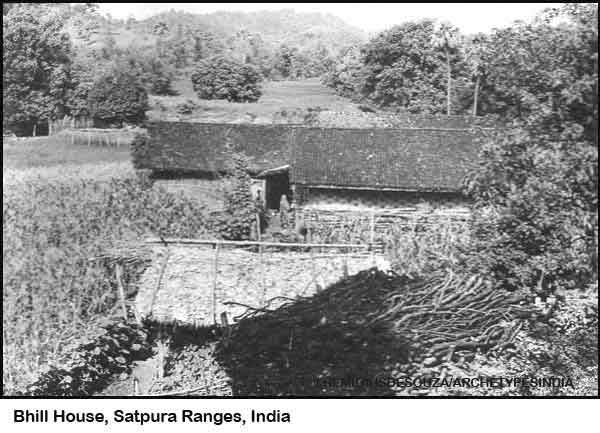
Bhill House and Habitat

 In the background is natural forest preserved 
by the Bhills
On the hill in the background is monoculture plantation 
initiated by the government 

 There are two kinds of poverty:
One is the way of life to live sustainably withou exploitation of resorces; 
Other is inflicted by the powerful section of society on others.

 
In this region there are Flurospar mines. It gives quality of 75% Flurospar of mineral content. When I visited (in the late 1960s), mostly Bhill girls were working at the mines as laborers. They received daily wages, while the ruling minority monopolized the resources: land and minerals, both. The exploitation of tribal continues even now. The world is certainly watching the growing Maoist or Naxalite movement in parts of India, mostly the tribal areas.

The story Bhills is not complete here. There is no need to romanticize Bhills. During lean periods when food-stocks (maze is their stapple food) vanish, many live on toddy, which is known to kill hunger.  


NOTE:
  When my classmates, schoolmates and colleagues were leaving India for Europe and America, and most, or some of them opted to settle abroad, I was wandering in the hills and valleys and deserts, particularly among the tribal - aborigines - communities. I was never a tourist nor I wrote any travelogues. I was looking for the people who have been existing before "civilized societies" came, that they are still here; I was hoping that my roots certainly have reached there.  

And my whole way of living totally changed, transformed: Say, without any rites and rituals or ceremonies I was converted. A religious conversion? No. Religion, like soul, love, work, fxxk is a much abused, and decadent. My wanderings fulfilled my life.

I publish these pictures for the first time. I have an uneasy feeling. I have a dreary feeling, if am I making a mistake? Because even though I believe in humans, but my belief in the so-called cultured civilized societies is dwindling. 

My papers 1: "Tribal housing: Buddha and the art and science of Karavi hut", and 2: "Tribal housing and Habitat-2", though they refer in particular to Warli Tribe, are applicable in general to other tribes, of course, with variations.

~ ~ ~ ~ ~
© Remigius de Souza, all rights reserved.

Monday, 28 September 2009

Dimensions of Sound at Kanheri Caves, Mumbai

Architecture of Sound- 2


 About 2000 years old rock-cut Buddhist Caves at Kanheri are now within the Metropolis of Mumbai. The Buddhist campus is located in the hills. This area is notified as National Park, a place of heritage of Forest and the caves too. I am ignorant of what it looked like then, two thousand years ago. But our experience there has been unique.


Chaitya at Kanheri Caves, SNGP, Mumbai
 

There are many visitors, particularly at weekends and holidays: Tourists, families, students, singles and couples. Sometimes some of the visitors have their fun of hearing the noise they make by shouting all together in the Chaitya. They perhaps learn something here? They experience reverberations. But the learning, unfortunately, does not go further than the noise of which they are used to in their urban life. Mass-mania! They perhaps also do not take notice of the notice put up there by the Archaeological Survey of India, not to make noise.

    In the empty (of other visitors) hall we, my student Nadakumar Jethe and me, spoke to each other. We stood some 15 meters apart. We began our conversation by a whisper, in low decibel. We raised our voice slowly until it was heard clearly by both of us.
    There were no reverberations.
    The sound level was lower than two persons talking to each other, sitting at one-meter distance in a crowded restaurant at a busy street-side in the city of Mumbai. How many monks did gather here for discourses, debates, and prayers etc? There are about hundred caves on the Campus.
  
      Imagine for a while, the Members of the Parliament of India, representatives of the people in the contemporary times, holding a session here in the Heritage building of Chaitya, on the hot issues of the country! They too, perhaps, may discover the Dimension of Sound (or SILENCE!), and its significance, not only in the Third Ecology – human ecology – but also in the entire ecology of Land (and Waters)! They too, perhaps, may acquire an ability to listen to the other beings, besides human beings, and the other happenings in the world of animals, insects, trees, reptiles, the night, clouds – lightning and thunder and droplets , breeze – storms and gales, water –  waves and floods and rain, the ground – the sprouting of a grain, and earthquake.
  
And also imagine about the teachers in modern education (and architecture) holding their classes here!
  
    We are generally deprived of leisure, an important dimension of life, as much important as Work, Education and Health, in these times of stress and strain, speed and efficiency. In the wave of visual aesthetics of hedonism we are missing, now and then, the other senses of existence. In here, going into the Earth, was like returning to womb ― a tranquil environment ambivalent for meditation – recollection  leisure; the mind and SELF face to face ―  listening to the soundless sound.


"The old pond
A frog jumps in.
Plop!'
         [Basho, Japan, 17th Century.]


Mumbai
17-9-1995

~~~~~~~~
© Remigius de Souza, all rights reserved.

Friday, 5 June 2009

Existence-Survival-Decoration: Painted Poem


I painted this poem in a state of mind that has no beginning - no end. This may be because of my wandering several places - cities, towns, villages, aborigine settlement in forests. Besides I was born and brought in a village in Konkan region, west coast of India, in my formative years. I wandered with purpose, without purpose, without any blinkers of caste - class, religions, culture, ideals, goals, civilised values, likes-dislikes; even to this date.

During one of these days of wanderings, this painted poem, materialized in 1985, (I didn't even record the date). In such a state the dimensions of time-work-speed-place-space are secondary. I wonder if this "painted poem" fits aesthetics of arts and letters? I doubt if it could be called art or a poem. I am sure it dosn't fit in any compartments created by civilised society, though the words seem familiar!

Not only this, but I doubt, if I could be called an artist in an accepted sense. But this need not block any one from self-expression!

While the graphic is fixed, the words are fluid. One may read it top down, or bottom up. The interpretations may vary with every person.

(World Environment Day: 05-06-09)
~~~~~~~
© Remigius de Souza, all rights reserved.