Showing posts with label Fifth World India. Show all posts

Wednesday, 3 April 2013

Mumbai for Women by Women

Remi’s open thinking on the issue


We appreciate the initiative “Mumbai For Women” by The Times Of India and IndiBlogger. We, however, feel women should take the lead for the action; hence “By Women” is added.

Mumbai and its Centralized Power


Mumbai's area, population and its socio-demographic-economic diversity are mind-blowing or rather mind boggling. But above all of them is its magnitude of power, or of the centralized power above the regions far and wide.

We have heard that 'power breeds corruption'. Power in every possible aspect of public domain shows corruption, not only economic but even intellectual, which may appear in form of dogmas.

The powers, legally or illegally, cause atrocities on weaker sections. The apparent causes could be any ? land, water, language, region, caste, religion etc.; gender is one of them.

We have seen children are made to beg by gangsters. Women and children become soft targets for atrocities.

Here we are addressing an issue of atrocities on women. These may be prevalent in patriarchal societies across times and places with difference in degrees. We are familiar with names of Sita, Draupadi etc. There have been cases of Sati, child marriages etc. in some societies.

But now the scale of atrocities is unprecedented.

For example: SC slams govt for equating housewives with beggars (HT, July 24, 2010)
It (SC) has also taken strong exception to the government clubbing them with prostitutes, beggars and prisoners in the Census.

I had seen the Census Survey of India of 1980, which mentioned this category. It also categorizes women them as ‘non-workers’, while in reality their share of work larger than males. Perhaps this practice has been going on since British Raj. Hopefully it might have changed now.

We can certainly say this is an act of offense (even by oversight or negligence) by the Government of India.

Mumbai is mini-India / mini-Bharat


There are the First World India, Third World India and Fifth World India (of the displaced and marginalized), and also the Fourth World India (of Adivasi – aborigines).

The Fourth World India is living in the backyard of Mumbai. Their women visit Mumbai, almost daily to sale forest produce, so that they can earn some cash for the family. Aborigines never settle in urban areas.

Of course, they are also living in the National Park at Borivali, since ancient times, long before Gautama Buddha was born.

Hence, we could say the Fourth World India, too, is now in the jurisdiction of Metropolitan City of Mumbai, by Design or Default, to expand Mumbai’s centralized power. Their status, however, in the city is not defined, or is forgotten.

Mumbai's Grey land-use zone – slums – proliferated in urban areas


This is the fallout of legal actions taken by the successive governments since Nehru Era, or even earlier during British Raj, for the Industrial and Economic Development. This has been done without due Rehabilitation of the affected, which creates social, economic, regional imbalance, beyond doubt.

It has also created a class of neo-rich, who indulge in splurge, consumerism… and indulgences! One may take a walk in Mumbai and be an eyewitness to the overpowering disparity and despair.

This is an assault on the weaker sections of the society; by default it affects women.

What is the role of 'For Women'?


If we recall Mumbai’s role in shaping India's freedom, there are many events. Here we mention only one: 'Quit India' movement that started at August Kranti Maidan in Mumbai. We deliberately refer this to Mumbai.

This is part two: 'For Women'. Forget men. Women must take the lead 'For Women'. This is not an elite kitty party. But the kitty parties also may join in.
The last part ‘By Women’

The women should take initiative and start the action. This third part may need some input: 'Learning from the People'. Women in Mumbai, however, should decide their agenda and their course of action. This is not an activism, but it calls for “action” at a personal level, first!

Learning from People: Women in Rural India


1. Among the aborigine communities there is No Gender Discrimination, no prostitution, no female foeticide. Widows and divorces can remarry. The youth (males and females) receive instructions about sex and marriage from the elders.

Besides, no one in their communities suffer from ‘Identity Crisis’, as in the Industrial Societies.

2. We have heard about 'Chipko Movement' started by Chandiprasad Bhut. Women of Bishnoi tribe in Rajasthan practiced it long ago.

3. Sitayana, instead of Ramayana, is composed in 'Ovi' form of poetry in Marathi by peasant women in Maharashtra. They speak about the injustice done to Sita by Rama (compiled by Tara Bhavalkar).

They indeed go beyond popular faith and/or beliefs.

4. Other example: Peasant women forced to shut down the 'licensed' (Read, Legal) liquor shops in their villages, in many parts of the country. They were harassed by their liquor boozer men in their families.

Everything legal does not necessarily mean to give justice.

Urban women, irrespective of their social-economic-political status, must take the lead and run this movement.

Action Plan for the Authorities


The Formative Age
 Any adult may check how the formative age has influenced her/his personal course of life; and also find out about the others - known or well-known persons. 

The criminals should be clinically examined by the social and psychiatry scientists as an ongoing research. What more a sick and decadent society could do?

Each offender/criminal should also be treated as a mentally and physically sick / lunatic person. Each one should be treated as a case-study, as if rare / rarest offense.

The details of their Formative Age, work and leisure activities, their companions, family background, education, socio-economic conditions... should be investigated.

In short, find out what leads them to commit any crime/s against females in the society. May the criminals be young or old, irrespective of their status in the society, higher the status of the offender rigorous should be the investigations.

The findings and results should be made public.

Investigate Social Aspects in Multimedia


Multimedia, here, include the cinema, television, Information Technology outlets, such as Internet, games on computers. Most vulnerable exposure to violence (hand-in-hand with love) takes place in cinema and 24x7 television programmes.

Women, being familiar with TV programme, should investigate and evaluate the programmes – serials, news, advertisements etc. On the TV there is always a band running that appeals the viewers for their objections.

Finally, it is necessary to come out of UTOPIA as well as leave the Web of VIRTUAL REALITY, and come down ‘DOWN TO EARTH of Reality’.
What is most essential is one has to go beyond personal likes and dislikes, and look at the whole issue Holistically beyond personal, in the Collective Domain.

Remigius de Souza

Note:

'Heroine of the Desert' by Donya Al- Nahi - I am reading this book (in Marathi, translated by Shobhana Shiknis). It is Donya's own real life story of her mission to bring back the children to their mothers; this is an Action, not merely activism. It is an example what a woman can do for the justice to women in distress.

Read More >>
1. Emergence of The Fifth World India
2. Indian Schooling
3. Nature (Science weekly) has recently published a special issue, Women in Science: Women’s work. A special section of Nature finds that there is still much to do to achieve gender equality in science (06 March 2013).
~ ~ ~ ~ ~
©Remigius de Souza, all rights reserved.

Friday, 18 January 2013

LEARNING AIDS IN BOOKS!

LEARNING AIDS IN BOOKS!

Survival and Life in Mumbai – Daily Bread

Image-1

Squatter Mother, Child and Hearth, in Mumbai

Two generations have born and grew up in Mumbai in subhuman conditions. But no one knows how to give them fair deal as citizens of this great nation.

Image-2
Mother and Father: Marathi proverb modified
In Mumbai about 60% persons live in "Grey Land Use Zone", which is illegal or unrecognized. They landless, homeless, displaced and marginalized in their motherland. The elite are chasing them away everywhere.

Image-3
Survival and Life in City: Mother's Little Helpers


Precious childhood learns life-supporting skills in the nursery school of Life itself: there is no better teacher anywhere. What memories would they carry as they grow-up? Who knows? They may not have entered even the Census Survey of India. 

Image-4
Mother Nature!, Give us this day our honest bread!
The marginalized and displaced have no demands even for their needs
from anyone.

Image-5
Learning aids - 1
This hawker on street has her kin and clan and close-knit community scattered in city: They don't suffer Identity crisis, though homeless in their Motherland.


"यही मुंबै मेरी जान ।"
This Mumbai My Love!

Image-6

Street vendor in Mumbai

This street vender, though s/he may be illiterate, but knows well:
  • about 'survival' (meaning, to live sanely) better than 'Authority';
  • about what things sell in this metropolis;
  • about life that teaches lessons in the country-wide-classroom;
  • about authority that is a faceless entity;
  • about glossy paper books that fail to teach lessons in Real Life, Down to Earth;
  • about the pampered kids pushed to live in the Virtual Reality, day in out;
  • And about how to save to her portable shop, from the baton...
Image-7
Street vendor in Mumbai

There are many dimensions to this frugal figure acquired through the glorious past, an Epic Poem in Person.

The elders hardly have time to take their kids to nearby places to look at vegetable & fish market, grocery shop, gardens and parks - though a very few, paddy farms on the outskirts of the city/suburbs or town, which offer innumerable variety in every aspect described in these glossy books, and much more.

Poor kids! Despite affluence they don’t have grandparents who could help, nearby...

Children have countless curiosities — questions, keen observation with all their senses, above all, their spontaneity and innocence!
But before long, before they see, experience and understand the real world around them, not even their immediate neighbourhood, they are pushed into Virtual Reality: Ready canned food, drinks, spices, views in TV, cell phone, MP3, Info-Technology.
At a tender age of 2-3, they are admitted into a public domain called 'nursery school', when they are not even introduced to their kin and clan: So they become 'smart' guys 'n gals.
This is rubbing salt on the wounded cohesive collective by the demise of joint family.
  • Can a school impart social values, which kinship and community could inculcate without a paid lecturer?
  • Could the Industry & Trade remove this social lack of values and morality?
  • Can a physicist and an economist sitting on high chairs at the helm of country's affairs provide answer with rockets and global market economy?
∴ The elders, each one, should try to find the answers.
(08-01-2013)

Life is larger than all Arts, Sciences, Religions, Philosophies, trade, technologies, States... through times and places, — Remigius de Souza

~ ~ ~ ~ ~
©Remigius de Souza, all rights reserved.

Tuesday, 15 May 2012

Booming Bamboo Feeding the West

Booming Bamboo Feeding the West


Key Words: West, here, refers to regions where bamboo doesn't grow or isn't cultivated. Bamboo, a wild grass, cannot be subjected to mass farming like wheat / rice. Feeding, in Indic cultures, is a verb for 'serving food' means, 'increase', which is by giving food it increases; it does not reduce. After eating, the guest says, 'God bless you', not 'thank you' as in English custom. Even the converted Konkani Catholics say, 'God bless you' keeping with the cultural tradition.

When I saw BBC news, ''Booming bamboo: The next super-material?', I was delighted.  I thought 'where does the sun rise today'! But after reading I wouldn't know to cry or laugh. Only my remaining disillusion vanished.
Bamboo artisans in Mumbai: Living with Dignity
Today, may it be democracy or dictatorship; both are under obligation of the visible-invisible capitalist powers. Unless these powers get a jolt like 'Arabian Spring', they may not learn the lesson.

Till now bamboo has been called, "Poor man’s persons' timber". The capitalist, they having enjoyed the taste for power and profit, overnight christened bamboo as, "timber of the 21st Century".

Under this sugar-coated name, the neo-colonialism is revealed in every word of this article. Is 21st century a magic wand?

See through the language of this story! It measures the bamboo production in 'dollar', and not 'tonne', not 'land', not 'life' of 'peasant-the-producer'! You never know when 'dollar' will slide down, and the bamboo producing peasants may face starvation! Such hypocrisy!

In the ad-world a lie repeated umpteen times may be sold as a truth by Goebbels’ propaganda, but it may not work forever is also true. The down-trodden notice it at once.
You never know when 'dollar' will slide down, and the bamboo producing peasants face starvation! Such hypocrisy!

Let us take example of our democratic nation.
From Nehru-era until now, who – any person/s, expert/s or pundit/s – spared a thought to the peasants in the country's six lakhs villages, then about 40 crores, now 100 crores, when and how, would they be able to build, manage and maintain the roads, bridges, schools, colleges, banks, industries etc. facilities in their villages by themselves?

Corporate Aesthetics of Hedonism
Or do they, submit to fate and continue live, ages after ages, as subjects or second class or the ‘Underclass’ of respective contemporary governments, forever?

Association of bamboo and villagers & aborigines is ancient. In the BBC story if there is anything new, it is the introduction to capitalize bamboo for mass production by the Industrial Society, where bamboo does not grow. That's all!
Mass production means 'centralization of power', whether by the state or the corporate. The corporate are known for their skill to capitalize anything — air, water, plants, animals, birds; blood... even poverty of the 'Other' — for profit and power.
Colonization obviously is followed by monopoly, market manipulation, intellectual property rights, scarcity... What happens to low-cost Housing, after Food scarcity, in the Third World, the Fourth World (of aborigines) and the Fifth World (of the displaced and marginalized due to development projects) worldwide?

The west is famous for making tool of economy to create great wealth and great waste.
There may be a number of products of lifespan, which is not even that of a rice plant. In no time there come new models in market. Old products go in scrap.

A paddy plant gives back fifty grains, but not even its speck goes waste, it turns into organic manure. And after daily meals, the crumbs or leftover is sent to birds, animals, ants-insects. These are our rural unwritten 'Standards'. Our government, however, always goes after Global Standards.

THE ATTRIBUTE TO DESIGN IN NATURE
“In whole organisms, randomness structure is uncommon. Everything seems finely tuned by brutal rigours of natural selection. There are no spare limbs to be found and hardly any dispensable organs. This forced economy of organism design has always limited the use of bodily form as evolutionary timepiece" (Martin Jones, The Molecular Hunt, Penguin 2002).

There is a saying, 'money goes to money'. How does it happen?
Capitalism has singular objective, money: Money is the 'means' and the 'goal'. When means and goal are one, a project is fulfilled.
Bamboo artisans belong to low-caste in India: Living with Dignity
For any democratic government, if its 'means' and 'goals' are 'People' for any project or objective, then only true progress is possible. Science, technology, currency... are merely tools without tangible value.

Bamboo or its grove is most virtuous icon of healthy community among plant world. It is friendly to all the living beings. Its equanimity is impeccable. Humans domesticated many grasses, such rice, wheat etc. in the ancient times, but bamboo did not need it. Bamboo – the eternal plant – belongs to sainthood.

For the advanced arrogant human societies, and their puppets (among many countries), there is never enough to learn from – Srishti – Mother Nature.
A note accompanies the BBC article:
‘There are as yet no international laws governing sustainability of bamboo plantations.’
The First World loves Laws, as if unaware of Natural Justice. Do the First World societies recognize that ‘Justice is above the Law’?
Bamboo: Image by BBC New
BBC story calls bamboo a 'green gold'. Siddhartha Jataka compare bamboo or bamboo-forest as "Cat's eye". Jataka stories, which date back to 300 B.C., are 550 in numbers and has mentioned bamboo and bamboo-forest more than hundred times. 

Read›› Booming bamboo: The next super-material?

Comment: They will buy carbon credits by planting bamboo by proxy in the Third World Countries at cheaper rates.
 — Remigius de Souza


~ ~ ~ ~ ~
©Remigius de Souza, all rights reserved.

Saturday, 15 January 2011

Slums, cities and the web of development - 4 The basis for rehabilitation


My address: At Mumbai, Post India 
Slums, cities and the web of development: 
4- The basis for rehabilitation

(A word of caution:  During 1950s and 1960s, it was alleged; thousands of acres of land were purchased by people in high places – politicians, business people, executives, etc. in various (bogus) names in rural areas. The recent Special Economic Zones (SEZs), if executed, could spell hell to the peasants, tribal and forest dwellers, which are treated as second class citizens. The social, economic, political, educational... disparities have pushed a large majority to the brink, which stinks of hidden agenda of annihilation.)

Rehabilitation should provide land for farming, housing, local institutions such as schools, colleges, training institutions for alternative agro-technology, banking, public transport, and health care faculties.

Squatters' water woes in Mumbai (2011)
Just as minimum shelter of 21 sq. m. is recommended / given to a slum dweller in cities, so also a landless labourer in rural areas should be rehabilitated with one acre of land.

All the land needed for rehabilitation of the displaced should be taken from reconstitution of the entire land holdings of the region. This formula demands corrective measures in the existing structure of laws and applications. But it also demands courage, integrity and transparency on the part of the society and Administration.

If such an application is brought into force, with effect from, say, 25-1-1952, there shall be massive exodus from the cities to rural areas. People who are rotting in the slums shall return to their homestead.

The culture and tradition of the country is essentially agrarian. The resources required for industrialization shall not last forever; neither the borrowed know-how, nor imported clever ideas of development that may work forever.

Customarily the compensation and rehabilitation is decided in proportion to, on the basis of degree of consumption and access and power to devour the resources in comparison with urban elite and not on the basis of sustenance. The direct benefit due to the acquisition for development must reach to the people on equitable basis. As is, it is questionable whether the benefits of direct taxes reach them.

Does science, or applied sciences, have answers to these problems? Perhaps partially. When ‘science’ loses its dimension of ‘people’ it becomes a ‘ghetto of information’ and eventually gets buried. Technology does not build the pyramids anymore in imitation of the past; its form, however, has changed but the context continues. When centralized power inflates and loses its vision of eternity, it disintegrates.

What memories of Mumbai these children will carry if they survive?
Incarnations and prophets born in different times spoke the language of people rather than the monopolized language of the elite. But now the times have changed. But peoples’ language is lost in the anonymity.

To look for the answers to the contemporary problems the real place is the people and not the polytechnics or parliaments or planning agencies, or theories and discourses by pundits that are not responsible.  Perhaps it is now time for billion incarnations.

The first task is to restore human dignity: Dignity to all living beings; Dignity to Life.

Author: Remigius de Souza
[Published in the Journal of Indian Institute of Architects, Vol. 61, No. 9,  Dec.1996, p23-25. This is edited version.]
(Revised on: 23-05-2010)

Links to previous posts: 
  1. Slums are on rise in India
  2. The slums increase in direct proportion to the development.  
  3. Ghettos of Development
Note: Photographs illustrated are by Remigius de Souza. 
~ ~ ~ ~ ~
©Remigius de Souza, all rights reserved.

Friday, 24 December 2010

Slums, cities and the web of development -3: Ghettos of Development

Slums, cities and the web of development -3
"... because there was no room"
3 Ghettos of Development

It is, of course, possible to rehabilitate the people within their homestead at countryside instead of displacing them, for so-called progress and development in the name of “common good”. Is it possible to rehabilitate the people who are marginalized due to natural calamity or human intervention? It is possible to rehabilitate them with dignity.

Under certain town planning acts the land holdings are reconstituted within city limits, for example by declaring town-planning schemes. Twenty-five years ago Vadodara City took care of all, particularly the small landholders that they do not loose their land while acquisition of land for public and social services for paltry sum of compensation.

Reconstitute Regional Land Holdings

Why then, should it not be possible to reconstitute the land holdings at the regional level while acquiring land for the development projects from where the people are displaced, or where the land acquired by paying cash compensations, and perhaps a promise of jobs in future, while creating the “ghettos of development” in the rural areas?
What is the value of cash compensation in the spiralling inflation and falling rupee value? Instead the local people affected by the development projects are treated as second-class citizens.
Is the administrative machinery ready and prepared to work hard for this job?

Compensation for the Acquired Land 


What is the basis of cash compensation for the acquired land?
Is it the current land price in the locality?
Is it based on the comparison with land value in the cities and metropolitan cities?
But don’t, however, cities, depend on the resources of the regions – at times from remote and distant areas for their sustenance?
Is the compensation based on the future inflated land value when the project becomes operative?
Is it based on the disparity of living standards of the urban elite and rural poor?
Or is the disparity in the literacy level and consumption level of both — those who acquire the land with the help of instrument of law and those from the land is taken — is a measure of cash compensation?
Or is it based on a theory that the people that depended on the very piece of land for ten thousand – or more – years, generation after generation, and will be deprived of the very resource – the land – for the posterity?
In what way the life of the people around the “Ghettos of Development” in the name of common good, in the areas of education and schooling, job and vocations, economic conditions, and services – post, transport, water supply, health…?
Until now they had depended on the soil for their sustenance while feudal lords, kings, rulers and emperors – Ashoka or Aurangzeb – came and vanished. And now in the independent India the ruling minority have taken their role? 

Who should get the rights to develop the waste lands in the country? It is worth a study. Perhaps only those who have strings and pull in their hand in the corridors of power could get the hold of wasteland. Instead, the marginalized and the displaced should have the rights on the waste land, with appropriate aid of technology, training and finance, and rights.

In any case, the present waste lands are the result of monuments and urban development of the glorious past and the ambitious present.    

Replace Slums by Humane Habitat

Is it possible to remove from, or rather replace slums by creating humane habitat in the cities and towns in India, and to some extent? Yes, if the people are given a fair deal in the development projects, out side of urban area, in the cases of public and private sector projects, including the areas brought under urbanization such as New Bombay built by CIDCO (City and Industrial Development Corporation) in Maharashtra State.

Take one of many aspects – the compensation for acquired land, particularly in the rural area. It is not only the owners of the land acquired but also entire affected population of village/s or region must be entitled to receive compensation. All are dependent on the land (and water) as a resource.

The nature and value of compensation and rehabilitation should be worked on the basis of and in the proportion of the total cost of the project, whether the land is acquired for a public or private project, which include mining projects. The total cost should include:

1. The cost of planning, administration, acquisition and arbitration processes from inception to completion stage: e.g. salaries, stationary, establishment, transport, conveyance, consultancy, services such as legal, technical, management, planning etc.
2. The investment incurred in the development, construction and establishment of infrastructure: A. civil works, rod, rail, buildings, machinery etc, and B. Services.
3. Annual compensation in the proportion of annual expenditure, but not of profit (loss) irrespective of subsidies and tax concessions, during the years of operations / life of a project.
4. When the life of a project is over, or its use and its owner is changed (as it happens when the government owned projects are privatized, in recent times,) the land must be restored back to the people.

The major curse of the so-called development projects is the land (and waters) gets degraded – dead – forever, whether the project is a success or failure, runs in profit or loss, or abandoned or changed.

Image: Squatters in Mumbai  

Squatters in Mumbai
Ghettos of Development: An Example 

Raigad had been a Notified Backward District. Proximity of Mumbai, availability of 'cheap' land and labour, and other facilities, hence, many industries found it lucrative for investment.
 
The environs of Rasayani and other industries here are inhabited by Adivasi Communities and other societies. More than three decades have passed, but the presence of industries have not changed their economic and health conditions for better, or improved literacy or education. On the contrary these industries have polluted the nearby Patalganaga River that affects fish and farming. 
Continued 4 


Author: Remigius de Souza
[Published in the Journal of Indian Institute of Architects, Vol. 61, No. 9,  Dec.1996, p23-25. This is edited version.]
~ ~ ~ ~ ~ 
©
Remigius de Souza, all rights reserved.

Sunday, 19 December 2010

Slums, cities and the web of development -2

Slums, cities and the web of development -2 


2 - The slums increase in direct proportion to the development. 


Most cities and towns in India have prepared development plans during last tree or four decades – mostly through the government departments. It is possible for city governments i.e. municipalities, to acquire land, to freeze the land use and municipalize the city lands for the purposes other than roads, gardens, commercial and city centres.

For example, Vadodara [Baroda] city (in 1960s) notified certain areas of land for “public housing” some thirty years ago. If Vadodara City can do it, then other cities too can find indigenous ways to deal with their problems.

It is possible to freeze the land use of vacant plots as well as areas of dilapidated buildings, which could be used for rehabilitation of slum dwellers, for redevelopment and revitalization of the area.

This could be brought about by “collective creativity” rather than by formulas and standards. This is possible when all citizens, not merely the professionals and the vested interests groups, become aware of the planning process. This is possible by creating a public forum.

Another example: Vadodara City (in 1965-70) rehabilitated 2000 families of slum dwellers whose huts were washed off in the flash flood of River Vishwamiti. They were given houses in five different safe places in the city. This was possible for two reasons: there was will on the part of the people of the city and the land was made available.

Today the slums at Vadodara have increased manifold. Are slums emerging as a new form of human habitat all over the country and elsewhere in the world while the humanity is on the threshold of 21st century? People use the phrase “21st century” as a magic wand. But the miracle is not coming off. The slums in the Indian cities have now become an ever-expanding phenomenon, which seems to have no end in future.

Slums are a result of territorial war and an invasion. It is slow, silent and unseen resulting from a partition where the powerful have opted for machine-energy to human potential, for power and profit. Perhaps the planners in their future development plans may have to paint grey-coloured-areas for slums in addition to other land-use zones in the city maps?

No one wants to leave one’s home and land, kin and community, and live in the rotten environment of slums in the cities. In Bombay, for example, during the World War II in the past and recent times during ‘the Textile Mill workers’ Strike’ and the riots, many people left the city, even though temporarily.

Exodus took place from Goa during the times of Inquisition during Portuguese rule, and during the partition of India – Pakistan from both the countries. It has been recognized that movement is associated with survival from proto-historic times for humans and other species. The slums are the result of desperate struggle for survival by the silent majority.

Who are these people in the slums?

They could be riot-affected, famine-affected, war-affected, the development-affected and economy affected, besides other causes. They are landless labourers, farmers, peasants, artisans etc. Adivasis – the aborigine – who are forest-dwellers, however, temporarily migrate to towns and cities for labour work during lean seasons of the year. They do have life-supporting skills and education, but are turned redundant due to the destruction of social and natural environment that helped them to sustain in the past. 

Contd. Part 3

Note: Author: Remigius de Souza
[Published in the Journal of Indian Institute of Architects, Vol. 61, No. 9,  Dec.1996, p23-25. This is edited version.]


* * * * * 
©Remigius de Souza, all rights reserved.

Wednesday, 15 December 2010

Slums, cities and the web of development -1: Slums are on rise in India

1- Slums are on rise in India 


The slum dwellers and squatters in Mumbai have risen to 60% of 110 lakhs population. They obviously are major vote bank in the metropolis. Obviously the politicians mooted an idea of “giving free houses’ to them.   

Either housing ‘for’ or ‘by’ the slum dwellers is an important issue, because it is the “people’s issue”, and its end does not seem to be anywhere in sight. It is important because in spite of so-called development and progress of science and technologies and the expertise in economics, politics, law, health [medicine], administration, management, info-tech, statistics etc. there seems to be no solution yet in sight.  

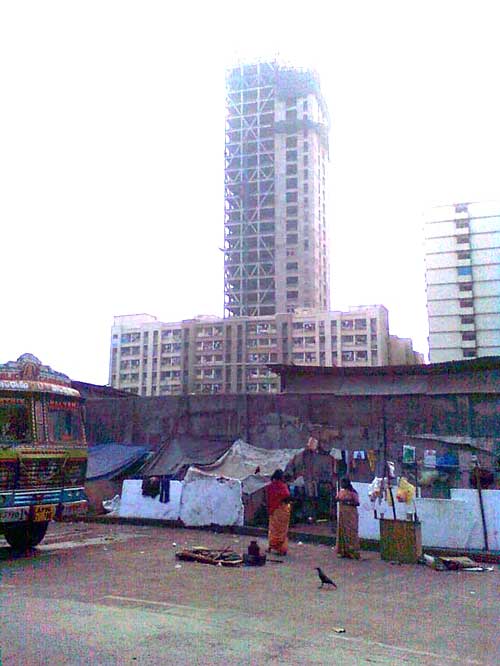
Squatters in foreground, Slum-dwellers in the free multistory building behind, Skyscraper in the background for the wealthy investors.
  
   For want of effective evaluation, ‘giving’ houses to the slum-dwellers and the rural poor, in spite of so much being done by the state, it has remained to the level of lip service. It pampers feudal attitude of the ruling minority. It cannot be termed altruistic as an end in itself.
  
   It is merely a postponement of treating the root cause by adapting ‘curative’ measures in fashion that we are so much habituated to modern medical practices. In dealing with this problem we must to the end of our rationale by looking at it from all the sides and from within it.
  
   The attitude, the mindset has to change from ‘curative measures’ to ‘care, preventive and corrective measures’. ‘Giving’ houses to the slum dwellers and the house-less is only a ‘curative’ measure, for self-gratification.

Do we learn from the mistakes?

What would the rulers do if there are many more earthquakes which may affect many more villages and towns?
How often the storms and floods have destroyed the houses, besides, other property and lives, in the country, and to what extent?
What has happened to the ‘Bhopal Gas Tragedy’ victims? How do these and such other events have influenced the planning and efficiency of action?
In what way these have affected our attitudes?
Do these problems belong merely to the ‘compartment’ of disaster management?
Or do they result in (futile) inquiry commission or tribunal, one more act, another department or one more ministry…?

In spite of so-called progress, planning and development the slums are on rise. They are not only in the metropolitan cities, but also in the small towns and along the transit lines, all over the country.

It is not impossible to deal with the problem of slums. But when the question of sharing the resources, equity, standards, energy, prices of farm and forest products etc. come up, the ruling minority, it may be proved, follow double standards. They turn out to be fundamentalist to claim that the development is for common good, not necessarily for the good of all. Hence the slums had been termed as illegal settlements. It is worth a study how metropolitan and large cities and mega-industries devour the resources of the land of the regions more than their due share… 

Contd. Part 2

Slums, cities and the web of development | Author: Remigius de Souza
[Published in the Journal of Indian Institute of Architects, Vol. 61, No. 9,  Dec.1996, p23-25. This is edited version.]


~ ~ ~ ~ ~ ~ 
©Remigius de Souza, all rights reserved.

Monday, 1 November 2010

Emergence of The Fifth World India


Emergence of The Fifth World India 


This scene appears in a public square in Mumbai.

The Fifth World India of the marginalized and the displaced is already on the scenario. And we presume it may also be worldwide phenomena. However nobody wants to acknowledge its existence, particularly those who wield power. 

The people are marginalized and displaced for various reasons. However the primary cause is Industrial Revolution and the Industrial Society that grew with it over a period of time, and their rapid, wild and unrestrained growth, progressively.

The growth of Industrialization certainly is out of proportion to entire population on, and the resources of the planet. It has created imbalance between regions and peoples, resulting in deprivation of basic needs – Food, Shelter and Clothing – for the economically weaker section, which is a large majority.

The Industrial Society, now labeled a Global phenomenon, wields monopoly over the resources of the Earth that belongs to all living beings – humans as well as plants and other animals.

Industrial Revolution is not ‘Universal’ like Agricultural Revolution. It remains in the hands of a privileged few. The rest are denied its advantages in practice, though it may not be on paper. This is not an altruistic attitude generally ascribed to humans.

Columbus discovered ‘New World’ while searching India. It followed not only colonization of new land and faith but also annihilation / enslaving of aborigines / local people. Vasco da Gama when landed at Mahim in Mumbai, then Islands of Mumbai, there was war at Mahim Fort. On winning the war the soldiers went around Mahim village and killed the unarmed villagers to create terror; typically colonization of land and faith followed power. A known history!   

Now the 20th century and its extension the 21st century have seen faces of Power, Colonization and Faith changed. They are now faceless entities, not a picture of personalized Maharaja, Map or Mother Goddess. Now they are Money (economy), Market and Machine (the make-believe-idol-of-salvation – Science and Technology). 

In India, tools with sexy and sugary names such as, Special Economic Zones (SEZs) are coined to facilitate the First World India, and to allure people at large as if it is boon for heaven of happiness. As if it will work like magic wand to bring progress and development to the majority second-class citizens in 600,000 villages (by “trickle-down” formula).

Perhaps it may work for the First World India of yours and mine who live in Virtual Reality, for the Presidents, Prime-Ministers and Political Party-leaders who reach their “level of incompetence” (The Peter Principle). The peasants, of course, don’t believe in their antics. Hence they have been electing “hung” parliaments and legislative assemblies for decades; but politicians don’t learn their lessons. 

The obvious fallout of development of last six decades in India is the increasing number of the marginalized and the displaced from the rural areas. They have been migrating in hordes to mega cities and urban areas to earn their daily bread in the hope of survival.

From Nehru down till now the Government of India follows the priority of progress and development on the western model, rather than facilitating knowledge to and educating the agrarian society in six lakhs villages to face the Challenges of Industrialization, particularly in farming (agriculture, aquaculture, forestry, horticulture and related fields) and Market. This should have been the primary task before a government of any brand – right/left/centre, religion, language, caste, religion, colour and dogmas.

Slum-dog Millionaire Mumbai 


Stone Age humans must have been working in this manner!

Mumbai, said-to-be financial capital of India, has population of 110+ millions. It attracts the Global Capitalist Corporate; of course, to market their unsold / surplus goods & reap profits. Their primary interest is Indian Market, not Indian People. The First World India welcomes them.

People of The Fifth World India, the legitimate citizens of India, marginalized and displaced from their homestead, are the victims of many / different causes, including the Action., Non-Action, and/or Failed-Action by the Government/s. They are the slum-dwellers and squatters, 60%+ of Mumbai's population.

The First World India's elite citizens in Mumbai have different reactions and responses to their presence in Mumbai, which is mostly negative and hostile, very few empathize.  However, now, the landmark slum at Dharavi is a target for redevelopment, for its Land at Prime Location to mint money, by land-sharks the Real-Estate Corporate: They, too, are not interested in the People. 

It is best symbolized by Mumbai City's land use plan: Typically this 'Grey Area' of 60 plus million habitants is not shown on the map. It is as if city land is a market commodity, not for humans use. Industrial Civilization turns land-water-air-space... everything including humans into market commodity.

Government floated ‘curative’ measure called ‘free housing’ under slum rehabilitation & put the slum dwellers in high-rise concrete slums. This cannot be called the Rehabilitation of the Affected People. It is a poor planning action, either long-term or short-term. (This requires a separate chapter for evaluation.)

The Fifth World is a Global Phenomena 
Hindustan Times News
                                        Instead of strengthening autonomy of the peasants, the thrust has been on the development of industry and necessary infrastructure it required. The language of farming is Universal; therefore, Agricultural Revolution could spread across the continents, when there was neither urbanization (civilized society) nor institution of government.

As a saying goes, ‘wherever civilization stepped, it left desert behind’; now in modern times, it is Industrial Civilization. Interestingly emergence of The Fifth World is not limited to India alone; it is now a Global Phenomenon. 

Industrial Civilization, in the name of ‘Social and Financial Development’ (H G Wells, The Short  History of the World), leaves irreversible desert in the human world by effecting slavery (earlier physical, now intellectual), destitution (by constant wars), poverty – hunger – starvation – malnutrition – marginalization – displacement (by monopolizing resources – land, waters, forests, minerals, on which Peoples led, for tens of thousands of years,  Sustainable Living) and complete disregard for their cultures): Now it coins a new verbosity – Sustainable Development!   

India, in the frenzy to bring Industrialization, made several Laws and Acts (which also include Development Projects, such as dams, cities, expansion of cities…) without Enacting Rehabilitation of the Affected People, by design or default. There is no effort to scrutinize the obvious fallout of previous/existing/defunct Laws and Acts, their success and failures. Neither India does learn from others’ mistakes.

Following the draconian British-made law of ‘Land Acquisition Act’ the government took over lands. The compensation came by way of Cash that had no tangible value. Our learned leaders, bureaucrats and judiciary never thought of how people live and survive, or their Ancestral Right to land. Now with few amendments the law remains!  

The Governments in India, at Centre and the states, while following various divisive policies, which results in pushing India’s plural society to polarization and further weakening the weaker section – a large majority, unilaterally followed to develop Industry (where there is Money), and conveniently ignored Gandhiji (who ironically appears on Indian Currency).

More on this issue:
  1. THE OTHER INDIA in THE OTHER WORLD (Review) 
  2. Urban Renewal in the Regional Context 
  3. ‘PRO-POOR’ – Election slogan by UPA-2004

Note: 1 Image, "Mumbai's Slum Population" Source: Hindustan Times, e Paper 17-10-2010
2. Images of squatters in Mumbai by Remigius de Souza 


~ ~ ~ ~ ~
©Remigius de Souza, all rights reserved.