Friday, 22 April 2011

Minimal, Minimalist, Minimalism Defined


Key Words: Minimal, Minimalist, Minimalism, Environmentally Sustainable, Art, Science

Minimalism started as a trend in art and design in the west. However, minimalist way of living, objects or artefacts have been existing from unknown times. Customarily it refers to art and design, which puts it in a box of a fashion, where a person may not 'walk the talk'.

Minimal is not minimum, but is to go beyond or achieve the best within minimum in living, thought and action. Minimal implies essential; it is not merely simple. It is neither junk or trash nor extravaganza.

Definitions, however, limit the scope of the defined. We, therefore, start with examples, and arrive at our definitions according to our perceptions. There is no formula! However, it may not be out of place here to add Universal Definition of Design by Nature written by Martin Jones, bio-archaeologist.

Let us start with primary and most familiar examples: Water (by Mother Nature) and Food: Roti – 'bread' (home made – by Mom).

Water is one of the minimalist creations by Mother Nature

WATER is fascinating Element: It soft, malleable, takes the shape of a container, always goes down the soil or to meet the sea, in heat vaporizes, moves meekly around obstacles on the way, cuts through rocks, mixes salts-minerals of soils… 70% of our body is water.

But there comes a time, when this taken-for-granted and often ignored element dances Shiva's Tandav of tsunami!

Water in Science
Water (defined as: 'H2O') is one of all the expressions, creations of Mother Nature! As a matter of fact, all her creations – from microbes to mammals, from algae to giant banyan – are minimal events. This sets an example and also a definition of 'minimal'. Mother Nature is our first and the last Guru!

Such tsunamis also happen in civilized societies. Whenever the arrogant and powerful classes / castes exploit and push the lowly – the sea of people – to the brink of subsistence, the waves of tsunami arise. This is the power within 'minimal'!

Roti as food is minimalist act

FOOD: vegetables, roots, tubers, grains, fruits... each of these have their unique taste, flavour and nutrition. They are also revealed by minimal process and in eating them fresh.

But having four meals a day, on full stomach, we can't fancy their tastes and nourishment; we find it ordinary. We become imaginative and add embellishments, decorations, ornaments... new experiments, processes in preparations of food.

There begins a market competition and struggle to make tasty exotic foods. It is just as we try to beautify our body as if... in this extraordinary creation by Mother Nature was incomplete!

Most elementary food is Roti – flat round Indian bread, and its regional variations. It is by now known in many parts of the world. Roti is made of flour of different grains: maize, rice, millet, finger millet, bulrush millet, barley or wheat. Rich Indian biodiversity also offers variety in various grains.

To make Roti all that you need are: Tava - a concave plate of clay or iron to bake, a wooden or metal plate to knead flour, salt, Chulah – hearth – of clay or just three stones, brush wood for fire  and, of course, water. I believed Roti is indeed a 'minimal' food, until I tasted baked maize loaf made by Bhill aborigines.

Henry D. Thoreau in 'Walden' (pp 99-101) writes about bread by Red Indians, which may not be different from maize Roti made by Bhill and other aborigines and peasants in India. Thoreau writes by experiments and experience of Indian bread, not by impressions.

Minimalist maize loaf by Bhill aborigines

Bhill Festival at Mahi River, Kadana, Gujarat

It was three day annual fair during spring on Chaitri Poonam (full moon day: this year on 18-04-2011). Bhills from Gujarat, MP and Rajasthan states had gathered on the white sands on bank of Mahi River among hills near village Kadana.

I camped there for three days and nights in the open (no bed, no sleeping bag) among Bhill families. At night all would sleep around campfires. They get up at an early hour. First the women take bath in the river, and then men follow. As I come out of warm water I felt thousand pin pricks. No sooner the Sun appears the water becomes very cold. After bathing it is time for breakfast.

Adivasi women started to prepare breakfast, before daybreak. They made balls of kneaded maize flour, wrapped each in the leaves of a specific plant and put them in the campfire. By the time bathing is over the freshly baked maize loaves are ready for breakfast.

The taste, flavour and nutrition of the maize loaf were extraordinary. It remained in my memory as unique and only experience of lifetime. And also the memory of their warm hospitality, though I was a total stranger.

Ingredients of maize loaf are flour, salt, river water, wooden bowl, leaves and brushwood fire; that's all. This could truly be called ‘minimal’ and 'environmentally sustainable' food and way of living, both.

'It is Walking, not the Way' — Vatsyayana      

Hunger is basic to body and mind. Food nourishes both, body and mind. Yet we are only custodians of our body and mind. In transplant operations heart is kept alive outside of body by supplying energy. Why boast it is my heart?

Minimal object is possible when one follows minimal 'way of living', which can't be called 'life-style': No compromises.
Ancient flute of bone 30000 ybp (Credits: NYTimes)

Note: There are number of "minimal" artefacts people use. Bamboo flute is has ancient origine. Archaeologists have discovered 30,000 years old bone flute some time back. I took my lesson on slate. People still take lessons on slate; Rangoli is another ancient example of "minimal" (land) art.Traditional nine yard Sari in India is single piece dress for women, which is a minimal artefact; many do not even wear a blouse. However a bikini, which is displayed on a fashion ramp, is only a minimum object, and must not be mistaken as minimal. In his paintings Raja Ravi Varma uses Sari for his female subjects. Haiku in poetry is indeed minimalist.

Rangoli inscribed on Mumbai's roadside pavement
Swastika in the centre of this image is repeated for ages
  a million times by women in India.
It is believed this action draws Cosmic Energies.
Remigius de Souza | Mumbai
22-04-2011

~ ~ ~ ~ ~ 
©Remigius de Souza, all rights reserved.

Monday, 11 April 2011

Indian Schooling

In the year 1947 India's population was about 400 millions, and 60% to 70% persons were illiterate. Presently there are 400 millions illiterate persons. What at the beginning of 20th century G. K. Gokhale attempted, to bring 'free and compulsory education to all, is still not fulfilled.


Indian Schooling

I HAD AN OPPORTUNITY to watch a short play on Door Darshan (DD), India's State TV channel, on 21-09-1989, in the afternoon transmission. It was on the occasion of International Year of Literacy. The play was about schooling. Now I, sort of, admire its main actors, Sulabha Deshpande and A. K. Hangal. I consider them to be respectable artists in the Indian cinema, TV and theater.

The play is obviously propaganda for the good cause of the spread of education by schooling. In the play an old lady (Sulabha Deshpande) wants the little boy to go to school so that he does not remain stupid like her old man (A. K. Hangal).

The boy looks after the goats and does not want to go to school. At last the old lady sells the goats. But the boy is upset. He refuses to go to school. He even attacks the other boys who come to take him bodily to school.

I wondered if Hangal and Sulabha pondered for a while over the treatment of the theme!
Here the goats are projected as the pets in the affluent families like pedigree dogs, horses, cats etc. For a villager a goat, cow, buffalo or hen is a means of livelihood.

Why then is the old man said to be stupid? Is it because he is poor? He is poor perhaps because he has been exploited first by British rulers and now by the industrialized society in India?

Why is schooling so important that one should give up the very means of livelihood – goats? Why is the rearing of animal so inferior? (Well. Some people consider that the goat is an enemy of forestation. Forestation means left over — whatever that is left after modern man — has eaten away the forest. Otherwise the goat is a sturdy animal which can live in the deserts as well as mountains, in hot as well as cold climate and is most economical to maintain for the poor. Its milk is medicinal.)

I wondered, couldn’t a goat, a tree, a paddy field, the making of an earthen pot, or moving of a plough in the field be part of schooling in India?

Why can’t actual cooking or preparing food, treating the sick, growing a kitchen garden, Milking a goat or a cow (the method of milking is different for each of these animals), making a toilet, urinal, treating garbage in the village, potatoes and onions, water and washing, sand dunes and ravines, cyclones and floods be part of schooling — actually, not merely verbally — not merely on the blackboard — either inside or outside the school building?

But the system the British started is so powerful that there is not much change except in nomenclature and timings.The so-called educationalists are still in the grip of the system started by the British. The play that was shown on DD is typical of the way the educated, the urban elite project schooling and education.

What if 5.57 lakhs of villages in India gave up rearing animals?

What if every family of 557 thousand households brings up graduates, masters and doctorates? Then, perhaps, those sitting in the chairs will lose the power game, of musical chairs; they play with lives of poor people. Finally, what is the relevance of present day English-made schooling in the eyes of these villages where 70% of the population is still illiterate?

This English-made system of education has not much changed since it started in this vast country made up of villages having a variety of landscapes, regions, climates, dresses, tongues, topography.

I take a little time off to ponder meanwhile this ‘natak’ (play or Tamasha) of Door Darshan brings insult and humiliation to realities of living in an Indian village!

For further reading: 1. Politics of Literacy in India; 2. Farming and the Politics of Education in India; 3. One Step Quantum Jump in Education; 4. Letters and Numbers, plus ‘Things to Make': Restructuring (Indian) Education 

Note: After twenty years I find this note is still valid. It has not changed the situation other than few numbers, while the population is growing. I republish it.

[Published in (1) GOGRAS, publishers Akhil Bharat Krishi Goseva Sangh, Vardha, India 442001, March 1990, year 14, issue 5, p. 236-7; (2) FOURTH WORLD REVIEW, Issue 44, p 14, The Close, 26 High Street, Purton, Wiltshire SN5 9AE, UK. 1990]
 ~ ~ ~ ~ ~
©Remigius de Souza, all rights reserved.

Friday, 1 April 2011

All Fools’ Day


All Fools’ Day 


Whatever may be, it’s my doing,
by choice or by force, that I forget;
my rush ends it in half-hearted doing
and in endless strife I am caught.

In my fear of loosing my doing
no moment spared to stop and look
from all sides around, inside out,
at all levels, in all dimensions:

much of it I am ignorant.
On the fast track of one dimension
never knew when I lost myself;
never realised I am the means;

and I am the end. A product, an idea,
a thought, an act, or a concept
in time is perishable and transient:
no sooner born belongs to the past.


In stagnant water all actions stink.
But waters of life are always flowing,
condensing, evaporating, raining,
reflecting; that’s the nature of water,

of life born in water, but not my doing.
In looking at doing, the doing ceases.
At the core of ocean prevails
Silence pregnant with new life.


* * *
Remigius de Souza | Mumbai | 26 March 2004
NOTE: 1. Image "The Fool" from Tarot pack is occult system, and has no connection to western custom of "April Fools' Day".
2. Image credits- "The Fool" from the Rider-Waite Tarot deck.
~ ~ ~ ~ ~ 
©Remigius de Souza, all rights reserved.

Wednesday, 23 March 2011

POWERFUL I FALL

I dedicate this poem, written on 03-03-2005, with deep reverence to the Tsunami that took place on March 11, 2011 at Japan, and the one that had touched India earlier. I wouldn't ever regret if I were hit by any such natural phenomena. ― Remigius de Souza

The Great Wave by the Japanese Master
Fuji off Kanagava
powerful I fall

air water meekly move aside
from any obstacle on their way
yet their presence inside - outside
in my world
I don’t even ever take notice
as much as of my towering ego
take them always for granted or
add some aroma.
it’s  pleasure to see them play
and sing photogenic as they seem
leisurely happily dancing together
at sea-shore
until suddenly they appear
in colossal shape size speed
a mighty dragon from the ocean
at my door
ransack everything on their way
as my nice world turns scary grey
I am stunned
in spite of all my might wickedest
of intellect and tools to dominate resist
powerless I fall.
Mumbai | 03-03-2005

~ ~ ~ ~ ~
©Remigius de Souza, all rights reserved.

Saturday, 19 March 2011

India, Bharat or Gondwana


India, Bharat, Hindustan, Aryavart, Tamilnadu, Malaydesh, Kalinga or Gondwana?
 
Ill. 1: Bhill children at Holi festival in Satpuda Ranges, Gujarat
Bhill aborigines in India do not use their thumb in archery to this date. 
Call this a living memorial of Ekalavya, or unwritten history.
Cult of Tree Worship and Holi Festival are animistic customs from antiquity. 
Other societies adopted them with different meanings and/or reference. 
Bhill's Holi Festival is unique.  

After our Independence there was debate on what should be the name of our nation; I read somewhere. Now I don’t remember particulars. In that discussion, it was impossible for 'Gondwana' to appear, even by accident. However, anyone uses any of the names, India, Bharat or Hindustan, according to one’s convenience/occasion.

Why did the wise citizens, leaders, historians etc. accept two names, India and Bharat? I fail to solve this puzzle, and I don't know what options they had. Perhaps this information is in government vaults under lock and key!

Word ‘India’ comes perhaps from 'Hind'. The Persian word 'Hindu' is derived from River 'Sindhu'. However, 'Bharat' is not a translation of 'India'. But why two names? Is this a sign of two minds or deceptive policy or inferiority complex?

Our neighbour Sri Lanka, a small nation, was also a British colony. But they had no difficulty to push the name 'Ceylon' away. East Bengal pushed aside 'East Pakistan' and by taking 'Bangladesh' preserved their identity.

Why then did we get stuck? In reality, we are very much in need of, and fond of, certificates from others, especially from the white people. And also we are fond of names (hero worship), to change names, also to call names!

However the name 'India' might have been continued as a memorial of our political and intellectual slavery. It is possible, if we see our craving for imported foreign goods that is visible after Independence. What to do? We also do very much love history or the Past!

I was going through a Marathi book on linguistics. Its basis was Marathi is Aryan language and it evolved from Sanskrit to Prakrit to Marathi. (I think the book is based on this hypothesis.)

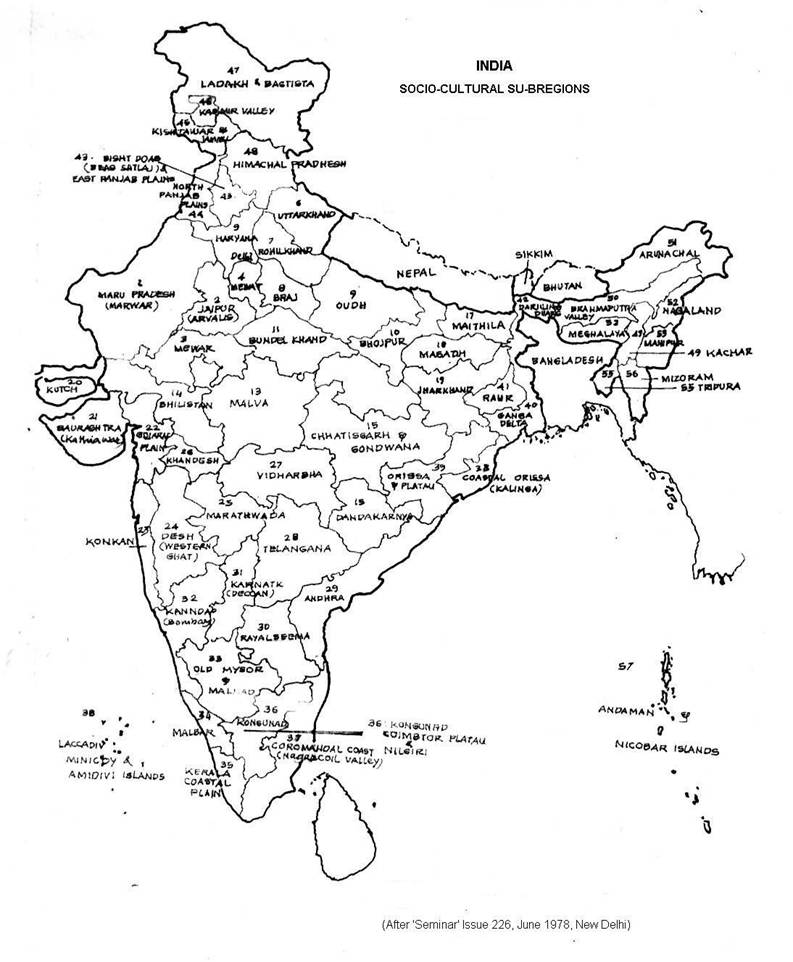
Ill. 2. Social and Cultural sub-groups in India
However, were there no languages in this country before Aryans came? Were not there other cultures and societies / communities? It is not mentioned in the book. As it is on linguistics of Marathi, there may be some limitations. Even then this missing reference is felt.

Something similar might have happened while deciding the name of our nation! They might have missed the context to the diversity of country's history, geography, society and culture etc. Whole attention may have emotionally been moving around Aryan culture!

Naming a Nation needs dedicated handling. Basically the British brought the scattered States and regions together and gave it a shape of a 'nation'. It should also be kept in mind that by this time the disciplines of archaeology and anthropology were well established.

Ill. 3: India in Vedic times (author unknown)
In Persian the region north of Vindhya ranges was named 'Hindustan.

The word 'Hindu' itself is Persian, derived from name of river Sindhu. Indus Civilization existed around river Sindhu. That civilization vanished, but people survived. Great empires / civilizations vanish, but 'ordinary' people prevail.

This is a simple lesson of history. God may be merciful, but Srishti - Mother Nature - is ruthless. Otherwise where are Aryans and Vedic culture today? Whatever culture is visible around today is probably a parody or adulteration or caricature?

Before Aryans came here there were Indus Civilization, Dravidians, and even long before them there were Aborigine communities. The aborigines had languages and cultures, and they do have even today.

Truly ever since Homo sapiens came in existence they received the gifts of language and culture from Srishti - Mother Nature. And they also received wisdom to change or transform their 'way of living' according to the state of place-time-environment.

All the aborigines of the world have their ‘way of life’ attuned to Nature. In other words: This is ‘religiousness’ imbibed in their body-mind-conscious for millennia; this is vocation (Sahajadharma); this is not a 'religion' or ‘magic’ that civilized societies are used to, or do understand.

Therefore, despite several and different assaults upon the aborigines by civilized societies time to time, those who survived annihilation, they continue to sustain until now. Living in natural environment, they are not in proto-historic state. However, having gone through the test time their 'will to live sanely' is extraordinary and steadfast.

But to deprive Adivasis – aborigines – of their natural habitat and environment by taking away or destroying it means to kill Adivasis; it amounts to annihilation even if they are kept physically alive.

It may be acceptable to the State by the prevailing laws, but it is not 'justice'. To impose civilized 'life-style' is injustice; their conversions to other faiths or dogmas are religious atrocity or blasphemy! There are no superior or inferior cultures.

In the Law of Srishti – Mother Nature – there is no room or regard for civilized orthodoxy. Moreover there is no place at all for any hierarchies created by humans in the realms of Mother Nature. Such civilizations are lost in the past. History is the witness. This is well established by the recent tsunami that hit Japan.

Historians, while writing history, have several subjective and objective constraints / limitations. History, however, by its residue – by-products – of its contemporary cause and effect, means-goals, is always / constantly present before us, and also within us by mimesis. One must have ability to read it with courage and impartiality.

During geological time, there are constant movement /upheaval in the Earth. But they may not necessarily be visible. In the history of Earth a super-continent separated into five pieces and spread out across oceans. They are present South America, Australia, India, Africa and Antarctica. But India then in the super-continent was not the same as is today; it was only the southern part of Deccan Plateau. Himalayas and North India did not exist then.
Ill. 4: Gondwana in the History of Earth (Source: scotese.com)

Eduard Suess [1831-1914], Austrian geologist did put forward the idea of super-continent (1861 A.D.) and named it 'Gondwanaland'.

Gondwana situates in central India, where Gond aborigine tribes live since unknown times. Even now there is (?) thick forest. Eduard Suess had no vested interest in India, Gondwana or Gond people. Indeed he was a world citizen.

Ill. 5: Map of Central Provinces (1903 AD) shows Gondwana


As civilized societies took over their habitat 
the Adivasis retreated in the remaining forests. 
A known eaxapmle is destruction of Khandav Wana in Mahabharata. 
Ill. 6: The British time map shows Gondwana in Central Province
 The British Map shows ‘Gondwana, but India/Bharat fails.

However, present Indian maps don't even mention the name of the unique region. Isn't this enough reason to show how mean and racist the present Indian rulers are?

While declaring 'secular state' on one side, how modern India, or 'the first world India', continues their Aryan racism is evident from this example! By ignoring their historical presence, the Govt. has eliminated the presence of entire Adivasi – aborigine – world, The Fourth World India!

In the Constitution of India there are these words, “India, that is Bharat”. (I am an ordinary citizen, and not an authority on constitutional matters.) By now, I understand, there have been about ninety-four amendments to the Constitution. Hundred years ago the British made a draconian law, 'Land Acquisition Act', which had been amended only about ten times. Now, we hear, it is being rewritten, anew?

Indian Republic has now passed 60 years. Though late, at least Supreme Court of India has awakened to acknowledge presences of Adivasis. On January 12, 2011 the SC of India gave an important verdict in reference to Adivasis – aborigines – of India, which reaches the first and decisive step.
(See link: India, largely a country of immigrants says Supreme Court of India
< http://remidesouza.blogspot.com/2011/02/india-largely-country-of-immigrants.html >) 

So far, this work is done by the 'Govt-the-Judiciary' of the Govt. of India. Now the work that remains is for the 'Govt-the-Lawmaker' and the 'Govt-the-Executive' to do. This is harder task to do.

It is harder because to remove or to break a 'mind block' is not an easy task. Boundaries of continents change; courses of rivers change; mountains erupt where there are plains; sea shores change; borders of nation change; once a super power USSR gets dissolved. What is in a name?

Beginning with the name, what historical errors Independent India / Bharat has been making? Whatever errors, they must be corrected. Then present errors in making / future errors could be avoided. This action certainly makes long range effects on national and international levels. For example, there may be resistance from the partisan Orthodox / vested interests, as well as new directions to thinking, and the honour of the nation will scale Himalayan heights.

Eduard has already introduced the meaningful historical name 'Gondwana' 150 years ago by naming the super continent. It refers to ancient 'aborigine peoples' and 'forests' on the Earth (Both are vanishing because of assaults and annihilation by the powerful civilized societies). Now only stamps of amendment procedures to the Constitution remain!

Gondwana: 'Gond' stands for, beyond the particular, all aborigines and also wandering – gypsy, Laman, Banjara, Romano, shepherd etc. – communities of the World who hail from ancient times. 'Wana' represents Forests, tree cover, natural / organic 'Agri-Aqua-Horti-culture' farming, but not mechanised-industrial farming.

From here onwards begins the chain of corrections of material and moral errors in the practices and policies. It also must begin with writing (or re-writing?) new textbooks on history, geography, civics, sociology, economics, politics, commerce, and other subjects, for the old and young generations.

Millions Unemployed people – the educated and the literate-illiterate – will get 'work' for this action in all regions; because the primary sources are the People. Hundreds of languages will get “scripts” and bring literacy that has been languishing for ages. This is more down to earth ‘urgent need’ and 'less costly' then sending a spacecraft in the sky.

'Lotus', the national flower, the seat of mythical Sarasvati, will then truly bear a thousand petals. May it symbolize the control over destruction of plants and forests; may the Adivasis and peasants, instead of just hearing words of promises, see in reality the days of 'plenty full water,  plenty full fruits' – Sujalam Suphalam – hopefully!

Remigius de Souza | Mumbai | Holi: 19-03-2011.

Note:
1. This post is translation from the original Marathi post published on author's blog Remichi Marathi Boli.
2. Illstration 1. Photograph of Bhill children was clicked 40 years ago by the author.
3. Illustration 2. Social and cultural sub-groups of India, after the cover page of 'Seminar', Issue 226, 1978, New Delhi.
4. Sources of other illustrations: Internet.  
~ ~ ~ ~ ~
©Remigius de Souza, all rights reserved.