We discover India, thereby ourselves, through community, culture, environment-ecology-energy, natural and human habitat
Monday, 30 October 2006
SEZ is out to kill a goose
Similar greed to has been going on by the local self-governments in the cities and metropolises; they auction or change the land-use to facilitate the builders and real estate developers, the land which is reserved for open spaces, social services and infrastructure, or which could be used for rehabilitation of the underprivileged n the cities.
Land grab goes to such an extent that metropolitan cities like Mumbai build several flyovers on the streets in densely populated mixed land-use areas, to ease the movement of automobiles only to shift the traffic congestion at the next point. Land-grabbing began with European entry. Where’s Portugal and where’s Britain and where’s Bombay (now Mumbai)? But one gave the islands of Mumbai to another in royal marriage as dowry. Since then land-grabbing has gone unabated by the westernised clones.
The great glorified imitators in India occupying high chairs in the establishments, by their political and money power, inside or outside the governments, are out to compete their colonial / neo-colonial masters.
Some powers in the international area indulge in terrorism in the name of peace, thus encourage counter-terrorism; in India our so-called democratic governments indulge in state terrorism in the name of progress giving rise to counter-terrorism: both leave millions of underprivileged to suffer, either way. The fat international / national awards and prizes only white-wash their gullible sympathies.
~~~~~~
Remigius de Souza
Postal Address: 69, 3rd floor 243 S.B Marg Mumbai 400028 India.
Friday, 27 October 2006
Skyline - Mumbai
Skyline – MumbaiPlace: Tulloch Road, a second lane behind the Taj Intercontinental Hotel in Mumbai, which is seen the background of the photograph. I worked in this locality for some time. On the other side of the Taj are the sea and the harbour, and in far distance the mainland. The place has hotels, bars, restaurants, curio shops, art galleries, street vendors etc, busy with tourists, working people, prostitutes and pimps, junkies and drug edicts… beggars and the rich.
Skyline: Roget’s Thesaurus gives about hundred words and phrases, besides adjectives, adverbs and verbs for the word ‘skyline’. Many of these meanings are applicable to this place: a good entertainment to find situations that relate!
Postal Address: 69, 3rd floor 243 S.B Marg Mumbai 400028 India.
Wednesday, 11 October 2006
Cola-Pepsi pesticide case in India
In the first place, why the cola/pespsi pesticide case hits the headlines?
- Because it serves the interests of the rich, the rulers, the elite on the either side.
- There also was bottled-water case of contamination.
- But why in the case of ground water contamination in many parts of India, though the reports appear in the ‘Down To Earth’, New Delhi, and other journals here and abroad, do not ever raise a protest / riots / fury?
By the time Narmada Bachao Andolan started, many corporations were deeply involved in the Sardar Sarovar Project. I had then felt, any government, at state or centre, which opposes the dam in any way, is sure to fall.
- That wasn’t the case of Silent Valley Project in Kerala. Thanks to late Salim Ali’s efforts and late Indira Gandhi’s intervention, the project did not materialised. Perhaps the times were different. However it is also known that India was pro-USSR.
Once (in 1980s) I was travelling around New Delhi. Some distance away there is a large industrial establishment (township). A street story that I heard: all political parties, whether in power or not, have been on its payroll.
While I was in Gujarat (1960s-70s), Baroda City needed water supply. The then Municipal Commissioner was in favour of option to bring water from the Narmada River by pipeline. However all the municipal councillors voted for the proposal of “tube wells” (by the patented French System) to install in the Mahi River; the system that supplies water to Gujarat Refineries.
- In the 1960s I was trekking Narmada Valley, its forested hills, around proposed SSP dam site. Any person in senses would have realised the enormity of damage the dam would have caused to the environment and ecology.
- Later the dam height, the estimates and the delays went on increasing in leaps and bounds
- I had already seen a part of saline desert where once a part of Indus civilisation was located, on the other side of Gujarat; indeed, wherever civilisation walked it left a desert behind. I had also seen thousands of acres of land that turned saline due to heavy irrigation by canal water in Khambat District.
Here, in Mumbai at Churchgate Railway station, there are two filthy places for drinking water taps. And twenty times more glossy facilities to supply bottled-water and fizzy drinks.
here are the Gullad-fame Lalu and Coca Cola-adversary George?
The capitalist society will continue to give Awards and Titles to like of Medha and Sunita, and support.
The corporation’s need is profit; the government’s need is cash, while people are put of until next election, or perhaps an imminent break-up. “IBM was supplying goods to the Nazis until 1941 in the full knowledge that they were being used in the concentration camps because it was their legal duty to increase profits and not to be concerned about the morality of it” (See: the book review of “THE CORPORATION – THE PATHOLOGICAL PURSUIT OF POWER AND PROFIT” Joel Bekan, by John Coleman, Fourth World Review, issue 138-139, 2005, UK, available online http://www.4thworld.co.uk/ ).
Now the Bollywood-Tellywood heroes and hoaxes go farting on TV screens to advocate how pure the cola drinks are, of course, for payment.
Moral of the story
Mother’s milk is the child’s need, not pills or packages of baby food.
Water is my need, but certainly not Coke/Pepsi even without pesticides.
¬ ¬ ¬ ¬
Remigius de Souza
Sunday, 8 October 2006
Justice by Law
by Remigius de Souza
The government of India, we have heard, is preparing / pursuing policies and strategies for urban renewal, biotechnology, and biodiversity. There, also, are recent Supreme Court verdicts on mill land in Mumbai, removal of slum dwellers in New Delhi, the height of Narmada Dam and rehabilitation of its oustees – the displaced. The countrywide fall-out of these actions may not be unpredictable. It seems in some cases people at large in the historical context don’t matter as much as the records of ownership of land – the legacy left to us by the British.
The governments, the judiciary and the citizens, not only the experts and planners, need continuing education and refresher courses which also should go through review time to time, in the Indian context, where everything is in flux and moving. How quickly they adopted the electronic and information technologies, and computers!
Now SEZ – Special Economic Zones – are being established, to make land available cheaply – without discrimination if and how it affects the Land, Water and the People, to facilitate the Corporate Sector to start new ventures at massive scale.
~~~~~~
Remigius de Souza
Postal Address: 69, 3rd floor 243 S.B Marg Mumbai 400028 India.
[08.10.2006]
Saturday, 7 October 2006
Strangle the Decentralization
Municipal Corporation for Vasai-Virar Region, Maharashtra, India
by Remigius de Souza
There is a move by the Maharashtra State Government, as appeared in the section of press (14 Sept. 2006), to impose a Municipal Corporation on the semi-urban Municipal Councils of Vasai, Virar, Nalasopara and Navghar-Manikpur and the surrounding 48 villages in the coastal plain and hills that have Gram Panchayats. Of course, it is motivated by greed for profit and power by the vested interest; the Government is the facilitator.
Vasai-Virar area, a part of Thane District, situates across the Mumbai, across the Thane Creek or Ulhas River, on the north. Mumbai’s suburban trains run up to Virar. The coastal plain is flanked by Sahyadri ranges on the east. This has network of tributaries of the creek, which are used for local transport during the high tides and fishing, and is a source of water for the saltpans.
As the land and real estate prices started soaring in the metropolis the people started moving out. In the metropolis there are lakhs of residential units lay vacant, built/purchased as commodity for investment, not as a need of shelter, while a large number of buildings are in dilapidated condition, slums apart. It also resulted in the spurt in building, mostly residential, around the railway stations in the Vasai-Virar area without planning, without water supply and social services, indeed chaotic conurbations. No economic expert or physical planner has any answer to this malady.
We heard from private gossip that the City and Industrial Development Corporation (CIDCO) woke up a couple of decades later, and some private firm was appointed to plan this area. Why should media take note of such issues, as they are not as glamorous as Hollywood – Bollywood – Tellywood figures? We know nothing more.
Now the imposition of Municipal Corporation on the semi-urban and largely rural region will only be disastrous to the land, waters and the people. Not only the pastures, orchards, flower and vegetable gardens, forest and farms will be destroyed by turning them into non-agricultural land, as is the precedent, for the benefit of empty coffers of the State, but it will further marginalize the landless peasants and the tribal, and push them to destitution.
The other evils are numerous which the citizens daily experience in the surrounding existing municipal corporations. Though the Chief Secretary boasts of ‘integrated development’ (whatever it may mean) the locals have already experienced the deaths by malnutrition of tribal children; the State Government’s record is very poor on many accounts. We can’t forget the martyrs of Sanyukta Maharashtra Movement, the farmers shot dead for demanding better price for their land acquired for Thal-Vayshet Project, the Nagpur assault on the tribal, and now the recent suicides of farmers in Vidarbha… besides the floods and riots and bomb blasts.
But the worst of all the ill effects, the 48 villages shall loose their autonomy by this imposition, thus nullifying the provisions and amendments in the Constitution for their betterment and empowerment. Decentralisation of power, besides transparency and accountability, is essential for governance. When institutions grow too large they become unmanageable. A banyan tree cannot stand on single stem when it spreads without adventitious roots. It is nature’s way: split, bifurcate or divide bodies, a cell or a community, from bacteria to galaxies.
Maharashtra, like other states, should be divided. Mumbai too needs to be divided into several corporations so that people shall have more say in their affairs. Mumbai has grown too large to manage for the corporation and the government, and many authorities that sit on its neck, now that it has grown beyond 100 lakh people. But the government is out to strangle the very concept of decentralisation with the noose of legal provisions on the existing 52 local self-governments in the Vasai-Virar region, instead of supporting and strengthening them.
The constitutional provisions and amendments for the villages remain on paper. The state government’s move to consolidate the centralised power on this region only amounts for short-term gains for a few and permanent losses to the land, waters and people may be called state terrorism – but without bang – with legal weapon.
Our benevolent government has started an education channel – “Gyan Darshan” – for the students on the TV. Who does follow it is a question. Perhaps the government could invest to start a 24x7 TV channel – “Gram Darshan”, solely for the six lakhs villages, by the villagers, and of the villagers, in all regional languages, of course, no advertisements, no entry to Bollywood – Tellywood stars, heroes and hoaxes. It should work mainly for the non-formal education for the adults, children and women. So also, All India Radio could start “Gram Bharati”, similar to “Vividh Bharati”. The corporate, however, may sponsor the programmes without any advertisements or even mention of their names; their rewards may be “tax benefits” if sanctioned by the Hon. Finance Minister!
What is needed is devolution of powers to Gram Panchayats. That needs to educate people. As a matter-of-fact, the constitutional provisions and the Gram Panchayat Laws should be taught at non-formal education for adults (if it exists) and at formal education in the primary schools in the rural areas.
~ ~ ~ ~ ~ ~
Remigius de Souza
27.09.2006
Postal Address:
69-243, S B Marg, Mumbai 400 028 India
[07/10/06]
The Pope and the Prophet
by Remigius de Souza
Thank heavens and hells here, and the Earth, which is mutilated by the civilised societies, that Pope Benedict XVI, or any other Pope, is neither Jesus nor Prophet.
The Pope is the head of the church, the oldest and largest, and perhaps one of the richest multinational corporations (MNCs); a Pope who claims authority is not exceptional. With the blood-soaked history of the Church behind, he quotes some insignificant long forgotten emperor – the sword in the hands of the Church; it suits him well. He didn’t find any quote from Jesus, the Son of God, or any prophesy by Him that there shall be Mohammad who shall have a link to Ishmael, a son from Abraham’s concubine, Hagar, his Egyptian slave, etc. etc.
The Buddha preached Ahinsa – non-violence, Jesus preached Love, Mohammad brought a message of peace, the religion of universal brotherhood; they had historical role to play. In his formative years of teenage the pope had flirtations with Hitler and Nazism; how would it surface in times to come, and how would Universal Church function? Wait and watch.
We have heard that one of the disciples of Jesus came to India. In two thousand years how many were converted to Christianity? But when the Portuguese landed at Mumbai, they had a war at Mahim Fort and they won. After the war they went around the place and butchered the civilians to strike the terror among them; the conversions of the locals followed by the missionaries.
The news about the pope appears while I am reading M. N. Roy’s “Historical Role of Islam: An Essay on Islamic Culture”, a dispassionate study published seventy years ago, and Sayyed Hossein Nasr’s book, “Islamic Art and Spirituality”, in the context of writings on Hassan Fathy’s architecture. Both books, so also Hassan Fathy, deserve the attention of Muslims as well as people of other faiths, in India as well as in the rest of the world, particularly in the West. I have neither read the text of the Pope’s talk nor do I have intention to procure its copy. I am only a Native Roman Catholic (native: not to mix-up my identity with European race/s, despite my name and surname) of India, a layperson; I have no say in Church’s affairs or its hierarchies. Spare me, O, Brethren!
¬ ¬ ¬ ¬
Remigius de Souza
ARCHETYPES 69/243 S B MRG MUMBAI 400028 INDIA
07.10.2006
Tuesday, 3 October 2006
Warli Housing and Art
Warli Housing andArt
by Remigius de Souza
“The concept of social art culminated in due course in the ugly Bauhaus movement, than in demonicSoviet realism and nearer home the Brutalist school of architecture in Europe, the United States and elsewhere, the omnipresent monument to the machine age at the service of ever-efficient capitalist economy”1
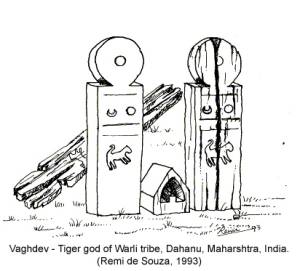
A painting on a wall, ‘Rangoli – Alpana – Kolam’2 on the floor fade away in time. The house too goes back to earth. In Holi festival a tree is burnt. This is also reflected in their ‘Vaghdev’ – tiger god. As generations pass away, the older stature of the pair is removed and thrown out of its place and a new one is placed. The last one takes the place of the discarded statue. It is the cycle of death and birth.
Painting, Rangoli, house, tree, Vaghdev’s statue… will regenerate in the cycles of death and birth. In the destruction there is beginning of new life – regeneration. The mud then is the potentiality of being lotus [Acharya Rajanish].
Why Warli is Warl? Warli is so close to mega-city of Bombay [now Mumbai], yet so remote?
This will always be beyond the perception of the ‘Post-historic man’, unless he changes his way of life.
~ ~ ~ ~ ~
Remigius de Souza
(Remigius de Souza, ‘Tribal Housing or Buddha and the Art and Science of Karvi Hut’, Paper presented at the CONGRESS OF TRADITIONAL SCIENCES AND TECHNOLOGIES OF INDIA, at IIT Povai, Bombay, 28 Nov.- 3 Dec. 1993
(2) http://remi.desouza.googlepages.com/warlihouseandhabitat2
1 Papworth, Marcelle. ‘Book Review of ‘Against Art and Artists’ by Jean Gimpel, Fourth World Review, No. 50, 1992, UK.
2 Rangoli: A line drawing/painting with pumis stone powder or rice powder, drawn in front the entrance. The stone powder is sometimes mixed with colour. Rangoli is also known as Alpana in Bengal, and Kolam in Tamilnadu.
(3/10/06)
Monday, 2 October 2006
Watering the farms: Learning from the people
Before pouring the water in the troughs or channels dug in the farms, they prepare cow dung slurry in water, and spread it in the beginning stretch of the channel. That helps to seal the pores in the channel and thus prevents water loss by percolation right in the beginning, thus it assures that water reaches to the end of the farm.
Theories of economics, or politics, or democracy may sound and seem glamorous, but the instruments of application matter. Richard P. Feynman, Nobel Prize winner in physics, is quoted by DR. Judah Kahn, to have said: “I was asked to assist in the creation of the world’s most destructive machine but I was never asked how to use it. Now I realize what I have done and the machine could do, and I am afraid” (Richard P. Feynman, ‘Don’t you have time to think?’ Ed. Michelle Feynman, Penguin, 2005, p. 361). Feynman died by cancer. (Was it due to the atomic radiation?) He was deeply interested in the mysteries of Nature, in the compartment of Physics, and perhaps missed Biology – his own body.
In modern society, while intellect takes topmost level, body – individual or the collective – is neglected, exploited, and oppressed. This is evident at national, regional and global levels in a great mass of human body of the underclass, the other living beings and the Earth; the corporate flourish. Do the numbers or statistics — one or one million, ten percent or ninety percent — matter, except for those who sit in the chambers, or move in a grove, or fly high and don’t see beyond their eyelids?
Unfortunately much of the resources – cash or kind, education or skills, which may be appropriate to 21st century – that are meant for the target groups on the lowest economic rungs are absorbed by the administrative channels of the governments; a known secret. Indeed, it is similar in nature to irrigation by pump sets, where water is wasted because of high velocity and volume, which is not controlled. It is high time, the governments learn from the people, and find the ways to plug the dissipation of resources. And please stop treating these people as second-class citizens and beneficiaries until the next round of elections.
Sadly, it seems Indian Democracy has lost its sense of proportion and priorities for last six decades, which claims to be a ‘developing nation’, of course at the cost of the Third World India (and the Fourth World India) that only benefits the First World India. We only hope the “PAYBACK TIME’ comes soon.
Late News: Where do the money go? Flood Fraud - January 12, 2007.
~~~~~~~~
Remigius de Souza (02-10-06)
© Remigius de Souza, all rights reserved.
Writing on Waters: My Epitaph
By Remigius de Souza
Imagine one half a century spent in the self-imposed silent exile while even while most of it spent in the public domain followed by a period of a decade exposing selfhood in private in public leaving behind the age of space and of time in the futility of existence of Beautiful Life continued encountering the very same ceaseless landmines exploding under my feet on my paths ceaseless I write my epitaph on the waters do wipe away O God my footprints from the paths I have walked upon at long last Who listened.
01.03.02 (Mumbai)(Rev. 02/10/06)
~ ~ ~ ~ ~
Remigius de Souza
© Remigius de Souza, all rights reserved.